
This analysis uses Complementary Law 214, Article 64, consolidated after Complementary Law 227/2026. Legislative research cut-off: 30 August 2026.
Imported SaaS and cloud: identify what the business purchases
Identify the purchased bundle and supplier
- Substance of the bundleThe contract should identify the rights, services and supplying entity behind the commercial label.
- Contractual supplierBrand origin and server location do not replace identification of the entity making the supply.
An invoice described as “cloud services” may combine processing, storage, a licence, support and implementation. The commercial description helps identify the purchase, but the contract must show which rights and services are actually supplied and by which entity.
An international brand may also invoice through a Brazilian entity. The analysis then starts with the contractual supplier, rather than the brand’s origin or the country hosting its servers. Equally, contracting with a foreign entity does not, by itself, settle the consumption question.
I would start the review by breaking down the purchase order: what is supplied, to whom, by which entity and against which payment obligation. That map connects the purchase to the Brazilian tax reform framework for technology and SaaS and helps prevent different obligations from receiving a single, unsupported classification.
Article 64(4) separately addresses situations in which an intangible or service is included in the customs value of imported tangible goods. The customs process for equipment should not automatically govern a subscription delivered over the internet. Complementary Law 214, Article 64, main provision and paragraph 4.
The payer may be different from the purchaser
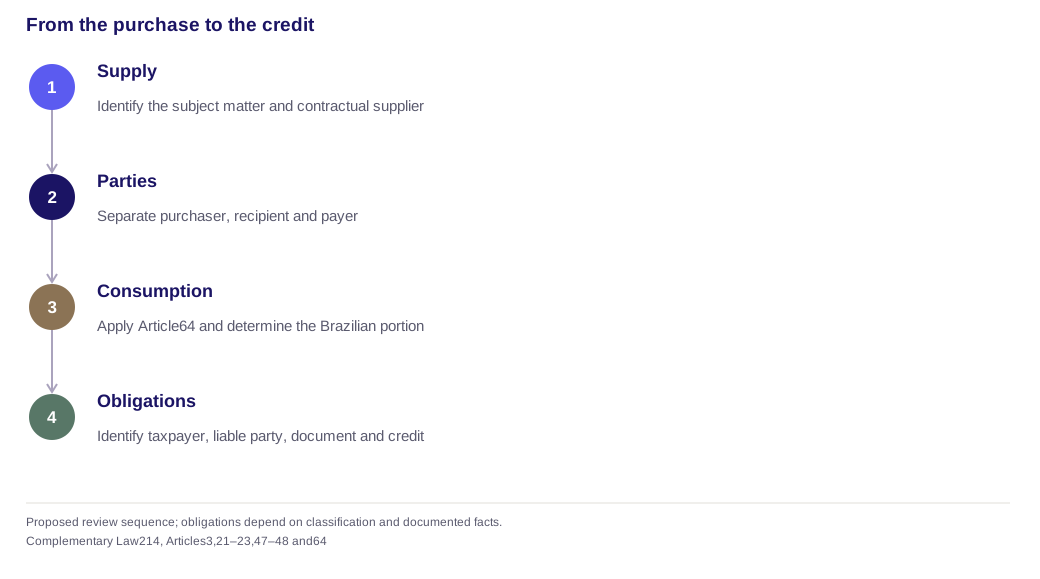
Article 3 distinguishes the purchaser from the recipient. The purchaser assumes the obligation to pay for the transaction; the recipient receives the supply. Where payment is made on behalf of or in the name of a third party, the purchaser must be identified by reference to the underlying obligation, rather than solely by the account used to transfer funds.
Suppose a foreign parent pays for a subscription contracted by its Brazilian subsidiary. The bank record identifies who settled the invoice. Identifying the purchaser still requires the purchase order, payment obligation and instrument authorising centralised payment to be examined.
The position changes where the parent purchases in its own name and supplies access or services to the subsidiary. Another supply relationship may need to be analysed. Confusing these arrangements affects both taxpayer identification and the holder of a potential credit. Complementary Law 214, Article 3(IV–V) and Article 64(5)(V–VII).
This distinction also informs a review of SaaS contract terms (Portuguese). The payment clause should match the actual arrangement, including centralised procurement and changes to the invoiced entity.
Determine whether consumption occurs in Brazil
Residence, recipient and mixed consumption
- Residual connectionA purchaser or recipient resident in Brazil can connect residual consumption to the country.
- Mixed useWhere consumption spans Brazil and abroad, the Brazilian portion needs a supported allocation.
Under the residual rule in Article 64(1)(II), consumption occurs in Brazil when the purchaser or recipient is resident or domiciled in the country. The specific place-of-supply rules in Article 11(II–IX) must be considered first.
This explains a relevant global-contract scenario: a foreign purchaser and a Brazilian recipient. The purchaser’s foreign residence does not, on its own, remove the import. The statutory “or” includes the recipient.
Determining the place of the transaction requires another step. For residual services, Article 11 uses the relevant principal domicile and contains registration rules, criteria for persons not properly registered, and a defined case for centralised acquisitions. The digital-services destination analysis (Portuguese) develops those requirements.
Article 64(3) provides that, where consumption occurs both in Brazil and abroad, only the Brazilian portion is treated as an import. This does not authorise splitting an invoice simply by counting users or IP addresses. The business must demonstrate which portion corresponds to consumption identified under the legal criteria. Complementary Law 214, Articles 11 and 64(1), (3).
Suppliers and platforms affect the allocation of obligations
Allocate the import roles before compliance
- PurchaserThe import review starts by identifying the person bearing taxpayer status for the purchase.
- PlatformProcessing an online purchase alone does not establish platform classification.
The purchaser is the taxpayer on the import. If the purchaser is foreign, Article 64(5)(VI) assigns taxpayer status to the recipient. The same paragraph addresses foreign-supplier and platform liability, referring to Articles 21–23.
A platform is not classified as such merely because it processes an online purchase. The law combines intermediation with control over at least one essential transaction element. In the case of a foreign supplier, Article 22(I) provides for the platform’s joint liability with the purchaser or recipient, in substitution for the supplier.
A significant registration exception applies: a foreign supplier is relieved of the registration specified in Article 21(2) when it carries out transactions exclusively through a platform registered under the regular regime. Using a platform for only some sales does not satisfy that exclusivity condition. Complementary Law 214, Article 22(1–3).
The foreign digital supplier registration analysis (Portuguese) sets out these situations. A contract may allocate invoicing and reconciliation tasks, but that allocation does not, by itself, change statutory liability.
Keep fiscal exchange conversion separate from bank cash outflow
| Hypothetical assumption | Calculation | Amount |
|---|---|---|
| Subscription price | USD 10,000 | USD 10,000 |
| Hypothetical selling PTAX applicable to CBS | USD 10,000 × BRL 5.00 | BRL 50,000 |
| Hypothetical commercial rate for the principal remittance | USD 10,000 × BRL 5.08 | BRL 50,800 |
| Difference | BRL 50,800 − BRL 50,000 | BRL 800 |
For imported services and intangibles, the taxable amount follows the transaction value and Article 12. For CBS, Article 13(4) of Decree 12,955 specifies currency conversion. A US-dollar transaction uses the selling PTAX rate for the day immediately before the taxable event; if no rate was published for that day, the latest available rate applies. Other currencies have their own rules. CBS Regulation, Article 13(4).
The fiscal exchange rate may differ from the commercial rate negotiated with the bank. The following example illustrates only conversion of a price component. It does not assume a tax rate or establish every adjustment to the taxable amount.
The BRL 800 difference does not itself create a CBS credit. It shows why a cash forecast should separately record the price converted for fiscal purposes, the amount paid to the bank, fees and taxes actually borne by the purchaser.
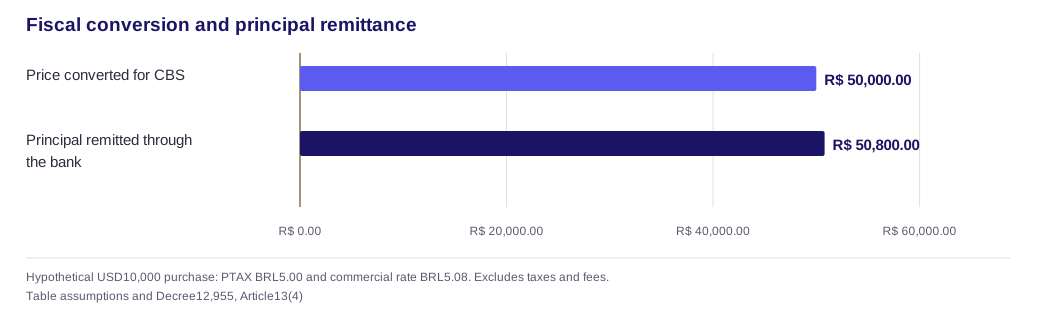
Chart data
| Category | Value |
|---|---|
| Price converted for CBS | R$ 50,000.00 |
| Principal remitted through the bank | R$ 50,800.00 |
Timing also matters. For continuous or instalment-based supplies, Article 10(3) considers the earlier of the relevant consideration becoming due and payment. Advance payments have specific rules. The rate should therefore not be selected solely by the date on which treasury chooses to remit funds. Complementary Law 214, Articles 10 and 64(5)(I).
When the import may generate a credit
From imported supply to recognised credit
- Eligible purchaserCredit recognition belongs to the qualifying purchaser under the regular regime and its conditions.
- No blanket promiseBusiness use of a subscription does not establish full credit in every case.
Article 64(5)(VII) allows a purchaser under the regular regime to recognise and use credits according to Articles 47–56. Its reference to the purchaser matters when the contracting party, recipient and payer are different entities.
Article 47 requires valid fiscal documentation and addresses discharge of the tax debt, applicable restrictions and separation of IBS from CBS. Article 48 provides a conditional exception to the discharge requirement, linked to non-implementation of the specified collection mechanisms; correct tax amounts on the fiscal document remain relevant.
These provisions do not support a promise of full credit for every subscription. Nor would it be correct to say that every credit, at every implementation stage, requires proof of payment by the supplier. The analysis should record the requirement applicable to the period and transaction. Complementary Law 214, Articles 47–48.
The financial difference becomes visible where cash is paid now and the credit can be used later, or where documentation does not yet support recognition. The IBS/CBS financial-credit guide (Portuguese) distinguishes a potential entitlement, credit recognition and use in the tax calculation.
What changes in 2026, 2027 and the full system
Keep transition assumptions explicit
- Test-year budgetThe statutory test-year treatment should be modelled with its compliance condition and legacy taxes.
- Future ratesPlanning estimates must remain labelled assumptions rather than universal statutory rates.
For 2026, the statutory test rates are 0.1% for IBS and 0.9% for CBS. Article 348(1) waives collection for taxable persons that comply with the required ancillary obligations, while paragraph 2 preserves payment of the previous contributions in full. Adding 1% as an unavoidable cost of every 2026 import can distort a budget. Complementary Law 214, Articles 343, 346 and 348.
From 2027, Article 542 repeals central PIS/Cofins provisions, including import provisions. ISS follows a different transition: Complementary Law 116 provides reductions in 2029–2032, with its repeal scheduled for 2033. A model needs to identify the scenario year before combining taxes.
Future IBS/CBS rates should not be populated using an estimate presented as a universal statutory rate. The law provides a rate-setting mechanism and rules depending on the supply and destination. Planning assumptions should be labelled as assumptions.
For documents, Joint Act RFB/CGIBS 4/2026 sets different start dates, including 1 December for ISS list items 1.03, 1.05 and 1.09. That does not establish a single date and document for every purchase called cloud. Joint Act 4, Article 1.
Documents needed to complete the purchasing review
| Proposed control | Evidence to reconcile | Decision affected |
|---|---|---|
| Parties and roles | Contract, order and payment obligation | Who purchases, receives and is liable |
| Subject matter and territory | Licence, scope, entities served and acceptance | Import, destination and any foreign portion |
| Amounts and dates | Invoice, due date, advance payment and currency conversion | Taxable amount, taxable event and cash outflow |
| Tax and credit | Fiscal document and relevant evidence of payment or discharge | Credit recognition and use |
| Adjustments | Cancellation, return and revised invoice | Reconciliation without duplication |
The review can be organised by supplier, with one line for each type of supply. Procurement, legal, tax and treasury should be able to reconcile their conclusions.
Article 74 of the CBS and IBS regulations addresses fiscal documents for imported services and intangibles. When required, the document must identify the foreign-exchange contract and invoice or supporting evidence; even where issuance is waived, evidence of the transaction or payment must be retained. Decree 12,955, Article 74 and CGIBS Resolution 6, Article 74.
The purchase may also require the other international-payment taxes and intragroup services analyses below. If the business also sells abroad, the software export test must be applied separately: its requirements are not identical to the import requirements.
Other taxes on international payments
| Tax area | What to examine | Main source |
|---|---|---|
| IRRF | Income character, beneficiary, residence and the first payment, credit, delivery, use or remittance event | Income Tax Regulation 2018, Articles 741, 765 and 767 |
| CIDE | Software licensing, technology transfer and technical or maintenance services | Law 10,168, Article 2 |
| PIS/Cofins-Import | Taxability of the subject matter, result, taxable amount and credit conditions | Law 10,865, Articles 1, 3–5, 7, 8 and 15 |
| Imported-service ISS | Service, customer or intermediary, establishment and municipal law | Complementary Law 116, Articles 1, 3 and 6 |
| Foreign-exchange IOF | Nature and settlement of the exchange transaction | Decree 6,306, Articles 11–14 |
Withholding income tax (IRRF), CIDE, ISS and PIS/Cofins-Import require their own questions about the international purchase. Bringing a cost within Article 64 of Complementary Law 214 does not settle its classification under other taxes. During the transition, the year of each taxable event must also be recorded.
End-user licensing and software distribution differ
Cosit Consultation Ruling 107/2023 examined an industrial company’s acquisition of software licences for end use. Its factual report states that the applicant did not sell the programs. The conclusion addresses IRRF on royalties and PIS/Cofins-Import, while distinguishing licences from maintenance for CIDE. Paragraph 77 contains a timing qualification for an adverse interpretation, which prevents indiscriminate application to any historical period. Cosit Ruling 107/2023, factual report and paragraphs 77–78.
Cosit Ruling 177/2024, by contrast, concerned rights to commercialise or distribute cloud-based educational software. Paragraphs 45–46 expressly distinguish that subject matter from the right to use software in Ruling 107. On those facts, the conclusion excludes PIS/Cofins-Import on separately identified royalties, subject to the qualification for associated services. It also concludes that IRRF applies at 15% and CIDE does not apply without transfer of the corresponding technology. Cosit Ruling 177/2024, paragraphs 45–47.
The purchasing implication is specific: tax must establish whether the business acquires a right to use, a right to distribute or a service. Calling the product SaaS does not remove that distinction. The analysis of proprietary, imported and third-party software (Portuguese) places the issue in the current system.
Each tax has its own amount, event and conditions
The Income Tax Regulation 2018, Articles 765 and 767, provides a 15% rate for the technical-services and royalties cases it addresses. This is not a universal answer for every beneficiary or international contract. Where a treaty is relevant, the agreement and protocol must be opened, their effective provisions and income classification checked, and the applicable conditions evidenced. No country-specific treaty is applied in this article.
For CIDE, Law 10,168, Article 2(1-A), provides a specific exclusion for remuneration for software use or commercialisation/distribution rights, except where the corresponding technology is transferred. Technical services have their own treatment. Both “all SaaS attracts CIDE” and “no SaaS attracts CIDE” would improperly bypass the subject-matter analysis.
For imported services, the general PIS/Cofins-Import rates in Article 8(II) are 1.65% and 7.6%, after confirming taxability. Under Article 7(II), the base comprises the amount paid, credited, delivered, employed or remitted abroad before IRRF withholding, plus ISS and the contributions themselves. Credits follow Article 15’s categories and the condition of contributions actually paid. Law 10,865, Articles 7, 8 and 15.
A net-payment clause can change the cash calculation
If the supplier must receive a net amount, the parties must identify who bears each tax and how that affects the relevant taxable amount. A table multiplying every percentage by the same net invoice can omit costs assumed by the purchaser under the contract. A review of pricing clauses (Portuguese) should precede a completed simulation.
For ISS, Complementary Law 116, Articles 3(I) and 6(2)(I), place and import liability must be combined with the applicable municipal legislation. For IOF, Decree 6,306, Article 11, places the taxable event at settlement of the foreign-exchange transaction. No municipal or transaction-specific IOF rate is determined here.
The year changes the calculation as well. Complementary Law 214, Article 542, schedules repeal of relevant PIS/Cofins provisions in 2027, while ISS follows another transition. Those limits must accompany the budget and supplier comparison.
Intragroup cloud and transfer pricing
| Test | Question | Helpful evidence |
|---|---|---|
| Supply and consumption | Who purchases and who receives the service in Brazil? | Contract, local order, usage rights and entities served |
| IBS/CBS price and taxable amount | Is there a below-market supply or an excluded amount? | Comparables, third-party documents and charging conditions |
| Transfer pricing | Is there a benefit and remuneration consistent with the functions? | Costs, deliverables, functions, assets and risks |
| Reimbursement | Was the expense paid on behalf of or in a third party’s name and documented in that party’s name? | Fiscal document and instrument identifying the third party |
A parent purchasing cloud for several group companies may centralise payments, provide its own services or participate in a cost-sharing arrangement. Those structures must be identified before deciding taxability, credit or remuneration. Articles 3 and 64 of Complementary Law 214 and Articles 23–25 of Law 14,596/2023 address different parts of that review.
Four tests the cost model should preserve
Law 14,596 governs transfer pricing for corporate income tax (IRPJ) and the Social Contribution on Net Profit (CSLL). Compliance with it does not replace the IBS/CBS taxable-amount analysis. Equally, calling a charge a reimbursement does not demonstrate compliance with Article 12(2)(IV) of Complementary Law 214. Law 14,596, Article 1 and Complementary Law 214, Article 12.
Benefit, duplication and the provider’s functions need evidence
Article 23 of Law 14,596 requires a reasonably expected economic or commercial benefit such that unrelated parties in comparable circumstances would pay for the activity or perform it themselves. The article also addresses shareholder activities and limits concerning duplicate services.
For technology services, this calls for a verifiable explanation: what reached the subsidiary, how it was used and which need it serves. A global charge without a description of the local benefit leaves the analysis incomplete. The business should also distinguish support actually provided from costs serving the shareholder exclusively. Law 14,596, Article 23.
When applying the cost-plus method (MCL), Article 24 prioritises individually attributable costs where possible and permits indirect charging under its conditions. Paragraph 6 extends the relevant provisions to the transactional net margin method (MLT) using a cost-based profit indicator. Selecting the method still requires its own analysis.
Paragraph 4 prohibits a markup on pass-through amounts for activities or purchases in which the provider does not perform significant functions, also considering assets and risks; paragraph 5 addresses remuneration for its own functions. That rule does not establish that a charge without a markup falls outside IBS/CBS. Law 14,596, Article 24.
A global contract may require three different analyses
Consider a foreign parent receiving the provider’s invoice and charging the Brazilian subsidiary. In the first scenario, it merely pays on behalf of the subsidiary, which is the documented purchaser. In the second, it contracts in its own name and supplies a service including administration, security or support. In the third, there is a cost-sharing arrangement whose participants assume risks and expect benefits under Article 25.
These are hypotheses for investigation. An invoice addressed to the parent does not, alone, select the answer. Contracts, licence ownership and actual functions must support the classification. The principal-versus-agent distinction (Portuguese) helps separate roles without replacing the tax tests.
Article 5(IV) of Complementary Law 214 covers certain supplies without consideration or below market value to related parties; Article 12(4) addresses market value. The CBS Regulation, Article 14, has its own comparison criteria. A transfer-pricing study can provide useful information, but it does not automatically establish that taxable amount.
The reimbursement exclusion still requires a transaction on behalf of or in the name of a third party and fiscal documentation in that party’s name. The cost-allocation and reimbursement discussion (Portuguese) develops that boundary.
A user matrix can help explain benefits and costs. It does not automatically become the Brazil/foreign consumption criterion (Portuguese), nor does it settle foreign-supplier registration (Portuguese). The review should keep those findings separate before consolidating the group charge.
Where a foreign SaaS purchase is arranged through an intermediary, review the Brazilian definition and obligations of a digital platform alongside the import analysis. The platform’s role, registration and control over the transaction affect responsibility; they do not remove the need to identify the purchaser, recipient and consumption of the service.
Frequently asked questions
Import conclusions that require conditions
- Subscription creditForeign business software does not generate an unconditional credit merely because it is used by the company.
- Centralised paymentPayment by a foreign parent requires identifying whether it purchased or paid for the Brazilian entity.
Does every foreign subscription generate IBS and CBS credits?
No. Article 64(5)(VII) refers to the regular regime and the conditions in Articles 47–56. The purchaser, documentation, applicable discharge rule and any restrictions must be identified. Business use of the software does not settle every condition.
Does payment by a foreign parent remove the Brazilian import?
Not necessarily. Under the residual rule in Article 64(1)(II), a purchaser or recipient in Brazil can establish consumption in the country. It is also necessary to determine whether the parent is the purchaser or simply pays on behalf of the Brazilian entity.
Does a foreign supplier always need its own registration?
Article 22(3) provides relief where the supplier carries out transactions exclusively through a platform registered under the regular regime. Direct sales or channels outside that condition require another analysis; having some platform sales is insufficient.
Does the bank’s exchange rate determine the CBS taxable amount?
Not necessarily. Article 13(4) of the CBS Regulation specifies the fiscal conversion rule, including PTAX, unavailable daily rates and other currencies. The amount actually debited by the bank must be reconciled but does not automatically replace that rule.

Discuss a concrete case from your company
30 minutes with a senior consultant. We map your specific tax scenario, identify the applicable opportunities and indicate the technical path forward — whether or not you continue with us.
Book a free diagnostic 30 minutes with a senior consultant. No obligation.