
Sources for the opening: Consolidated Complementary Law 214
This guide organises the analysis for management, finance, legal, product and technology teams. Each decision links to a specialist analysis with its legal basis, documents and examples. Simulations are hypothetical; rates used for sensitivity analysis are not definitive rates set for the sector. Some linked specialist articles are in Portuguese.
First describe the operation generating revenue
| Observed model | Decisive question | Further analysis |
|---|---|---|
| Own or third-party licence | Which regime applies to current revenue? | Software origin and rights |
| Subscription, implementation or usage | When does each event occur? | SaaS billing models |
| Intermediation | What is the operator’s own remuneration? | Platform commission and tax base |
| Payments to third parties | Is the on-behalf-of arrangement supported? | Reimbursements and documents |
| Platform controlling a transaction | Are classification and statutory liability established? | Article 22 requirements |
| Foreign customer or supplier | Who acquires, receives and consumes the supply? | Destination of digital services |
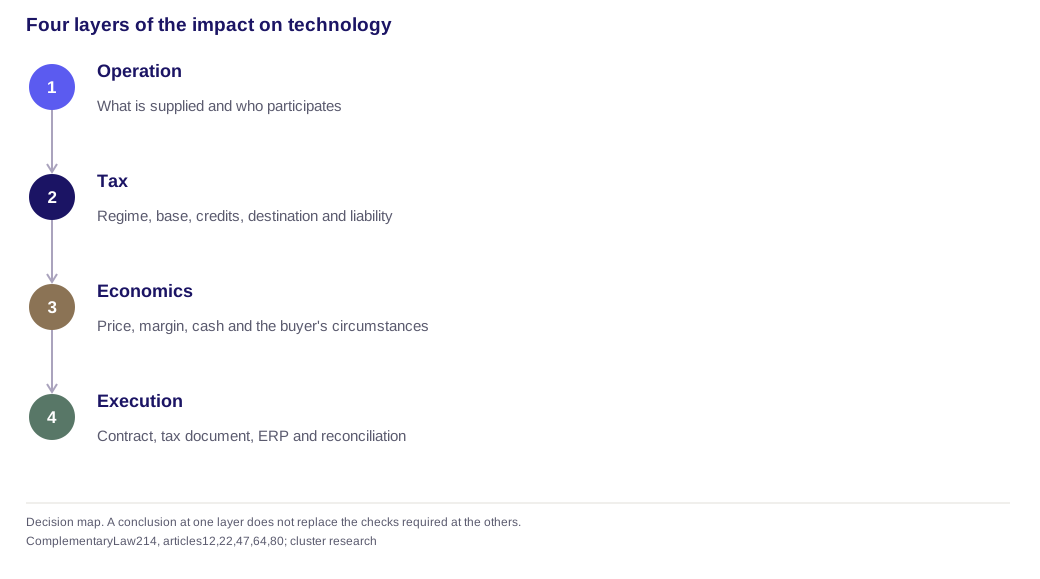
A “technology company” is not a single taxable operation. A business may supply its own software, resell rights, provide consulting, perform a customer’s process or intermediate between suppliers and buyers. These functions may coexist, and the remuneration for each must be explained.
Classification should start with the contract and what is delivered. It is necessary to establish who assumes the payment obligation, who receives the supply, who controls the right and how the business is paid. Accounting categories, the Brazilian activity code known as CNAE, and the brand displayed on the interface are useful information, but they do not replace the relevant facts.
Review the current burden before projecting the new one
Establish the baseline before forecasting
- Current balanceOutput liabilities, credits and the resulting balance should remain separate in the baseline.
- Revenue timingRecognition, invoicing and cash receipt should not be treated as one event.
Lucro Real, Brazil’s actual-profit corporate income tax regime, does not make all software revenues subject to non-cumulative PIS/Cofins. Article 10, item XXV and paragraph 2, of Law 10,833 contains an exception. Cosit Ruling 218/2024 distinguishes nationally developed own software from third-party or imported software in the situation examined. A study applying 9.25% to all turnover may start from an incorrect baseline. Law 10,833, articles 10 and 15 and Cosit Ruling 218/2024.
The company should separate gross output liabilities, credits and the resulting balance. The article on cumulative PIS/Cofins within Lucro Real explains the exception. The mixed software and consulting revenues guide shows reconciliation and an example of allocating an eligible common cost.
Revenue recognition, invoicing and receipt of payment must also be distinguished. The analysis of accrual recognition for SaaS examines Cosit Ruling 15/2026 and the risk of automatically dividing every annual contract into equal periods without supporting the corresponding performance. Cosit Ruling 15/2026, paragraphs 34–51.
Tax base: the company’s own revenue and third-party funds
Own revenue or third-party flow
- Economic roleThe business must establish whether it supplies, intermediates or receives a qualifying reimbursement.
- Own acquisitionCalling a cost a pass-through does not make the customer the acquirer.
The difference between BRL100,000 transacted and BRL10,000 in remuneration can be decisive, but it is not enough to choose the lower amount. The business must establish whether it supplies on its own account, intermediates another person’s transaction or receives a reimbursement meeting the statutory conditions.
Article 12, paragraph 2, item IV, provides for exclusion of reimbursements under the specified conditions, including tax documentation in the third party’s name. If the company itself acquires the supply, calling the amount a pass-through does not make the customer the acquirer of that transaction. Complementary Law 214, article 12.
The review should connect the principal-agent test with the tax analysis. Businesses organising document-related tasks or payments to notarial offices face particular questions concerning notarial fees, pass-throughs and credits. The legaltech and document outsourcing analysis brings those flows together without assuming that all remuneration is commission.
Platforms: establish classification before assigning obligations
Classify before allocating obligations
- Actual functionIntermediation, control, exclusions and liability must be examined together.
- Operational capacityA statutory option does not prove that every system can already implement it.
Not every software product used in a sale is a digital platform liable for IBS/CBS. Article 22 establishes intermediation and control requirements, exclusions and situations of liability that must be read together. The business must understand its actual role in billing, payment, transaction terms and delivery. Complementary Law 214, article 22.
After platform classification, the work proceeds to liability for the tax, issuing documents in the supplier’s name and the option to act as a substitute taxpayer. A statutory possibility should not be treated as an operational option already available in every system.
Partners’ tax records must support those choices. Missing or inconsistent information about the supplier, regime and acquirer is not resolved merely by a general contractual liability clause.
Credits: classify expenses and understand the buyer
From expenditure to usable credit
- Acquisition ruleEconomic necessity does not replace the statutory conditions governing a credit.
- Buyer profileBuyers in different regimes and sectors should not receive the same credit promise.
Article 47 links credits under the regular regime to statutory conditions concerning the acquisition, document and extinguishment of the relevant tax liability, subject to exceptions. The economic concept of a necessary expense does not replace those rules. Personal use, the supplier’s regime and specific provisions must also be examined. Complementary Law 214, articles 47–57.
The technology expense matrix distinguishes acquisitions and their requirements. Payroll and employee benefits require additional care: a voucher’s face value is not a universal credit base. The guide to credits on purchases from suppliers includes the distinction for Simples Nacional, Brazil’s simplified regime, without assuming either no credit or full credit for every acquisition.
On the commercial side, buyers may face restrictions. A regular-regime company, a Simples taxpayer, a bank and an investment fund should not receive the same promise. The analysis of software sold to banks and other financial businesses separates acquisition credits from deduction of expenses when calculating the financial-services tax base.
A credit also does not mean immediate cash. The financial credit and refund guide explains conditions, timing and limits. Split payment and assisted tax calculation require reconciliation without duplicating payments or assuming the proposed balance is correct.
Price and contract: decide who absorbs the economic effect
| Variable | Question for management | Document or test |
|---|---|---|
| Price | Is the contracted amount before tax or inclusive? | Proposal and tax clause |
| Acquisitions | Which costs support a valid credit? | Acquisition matrix and documents |
| Customer | Can the buyer use the credit? | Confirmed legal and tax profile |
| Timing | When do tax, credits and cash flows occur? | Calendar by event |
| Change | How will rate or scope changes be handled? | Negotiated clause and governance |
Article 12 excludes IBS/CBS itself from its tax base. This requires care when comparing prices before those taxes with the total price. If a customer fixes its outlay at BRL100,000 and the hypothetical tax rate is 26%, simplified revenue before these taxes is BRL100,000 divided by 1.26, not BRL100,000 minus 26% of that total. The rate is only an illustrative assumption. Complementary Law 214, article 12, paragraph 2, item I.
The effective-burden model, B2B SaaS pricing analysis and scenario calculator show the calculations and their limits. The objective is to discuss the decision with transparent assumptions, without promising neutrality or the ability to pass the effect to customers.
A SaaS contract review includes obligations, enforceability of payment, documents and events. Public administrative contracts have their own economic rebalancing rules. Late payment, cancellation and discounts receive different treatment, developed in the SaaS event guide.
Imports, exports and foreign suppliers
An international flow does not finish the test
- Relevant partiesThe acquirer and recipient must be identified in the international supply.
- Insufficient signalForeign currency or an overseas payment does not independently establish import or export treatment.
Under the new system, article 64 governs imports of services and intangible goods, while article 80 governs exports of that category. The identity of the acquirer and recipient matters. Receiving money from abroad or contracting in foreign currency does not conclude the analysis. Complementary Law 214, articles 3, 64 and 80.
The imported SaaS and cloud guide separates the international acquisition from other taxes that may require examination. The software export guide explains conditions and evidence without treating a foreign address in the contract as an automatic conclusion.
A foreign digital supplier must examine liability and registration, including where a platform intermediates the supply. Centralising payments among group companies must preserve the legal identity of those acquiring and receiving it.
Calendar and ERP: obligation, version and deployment are separate controls
Three layers of operational timing
- Relevant caseDocument, transaction and regime determine which milestone must be examined.
- EnvironmentPublication of a technical note does not prove that its functions are deployed.
The transition includes different dates depending on the document, transaction and regime. Joint RFB/CGIBS Act 4/2026 distinguishes document-issuance situations, including certain software services and platforms. The operation must be classified before selecting a deadline. Joint Act 4/2026, article 1.
A published technical note may contain functions not yet implemented or rules scheduled for future production deployment. The analysis of IBS/CBS in tax documents should therefore not be reduced to one date for all companies. The NFS-e guide for software and ERP tests translate the research into test scenarios.
The company must also consider the Simples decision for 2027, effects on the buyer’s credit and PIS/Cofins balances during the transition. The consolidated calendar distinguishes legal milestones, deadlines and operational conditions.
Conditional rate reductions do not follow the company’s name
A reduction requires object and conditions
- Commercial labelSecurity, compliance and legaltech labels do not grant a reduction on their own.
- DemonstrationThe actual object, provider and applicable requirements must be supported.
A solution marketed as security, compliance or legaltech does not automatically receive a reduction. Article 142 and Annex XI of Complementary Law 214 address specified security-related situations. Article 127 governs certain professions and conditions of supply. The actual object, provider and applicable requirements must be demonstrated. Complementary Law 214, articles 127 and 142 and Annex XI.
The analyses of information security and IBS/CBS reductions and legaltech and professional services explain the limits. Classification should not be selected merely to produce a lower rate in a commercial proposal.
Turn the map into a sequence of decisions
From inventory to review
- SequenceInventory, classification, measurement, negotiation, implementation and review connect analysis to execution.
- Decision trailEvery stage should preserve its source, document, unresolved assumption and owner.
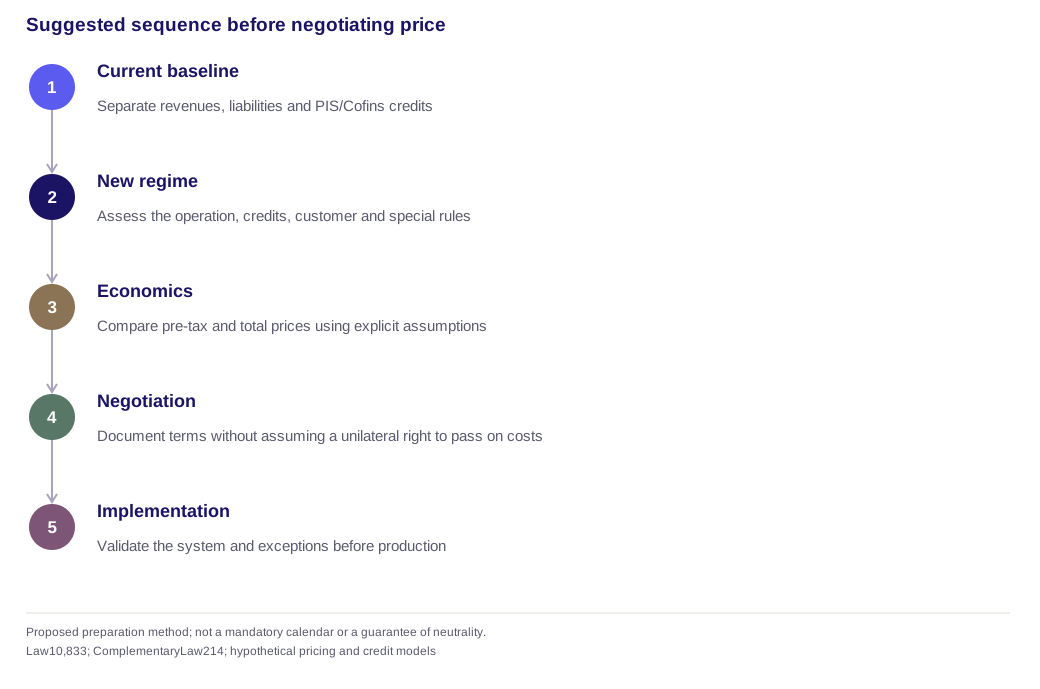
The business can start with material operations and changes carrying deadlines. The suggested sequence is to inventory, classify, measure, negotiate, implement and review. At each stage, the decision should identify its source, document, unresolved assumption and responsible person.
The digital operations matrix brings together hypothetical examples for discussion. The technology and SaaS diagnostic connects the analysis to deliverables and implementation. The intended result is a decision the business can execute and explain, while keeping unresolved conditions and uncertainties visible.
ISS and precedents: identify the question the judgment answers
| Question | Reference document | Limit |
|---|---|---|
| ISS on customised licensing | Theme 590 and facts of the supply | Does not make every technology dispute identical |
| Software revenue regime | Law 10,833 and Cosit Ruling 218/2024 | Requires identification of development, origin and transaction type |
| IBS/CBS base and credits | Complementary Law 214 and applicable regulations | Do not follow automatically from the previous ISS classification |
| Refund of tax for a past period | Payments, proceedings and relevant decisions | Requires review of temporal effects and the specific position |
In Theme 590, RE688,223, Brazil’s Supreme Federal Court recognised the constitutionality of ISS on licensing or granting rights to use software developed on a customised basis, under item 1.05 of the service list in Complementary Law 116/2003. That is the scope of the holding; it does not determine the PIS/Cofins regime or entitlement to IBS/CBS credits. STF Theme 590, official holding and docket.
A review should separate three questions: which tax applies to the licence under the system examined in the precedent; which contribution regime applies to the revenue; and how the supply will be treated for IBS/CBS. An answer in one area does not replace the legal basis needed in another.
For earlier periods, copying a holding from a portal is insufficient. The decision, any motions for clarification, temporal effects and payments must be examined together. The STF docket records judgment and finality, but a truncated docket entry should not be used as the full account of every qualification concerning temporal effects.
The article on the PIS/Cofins regime for software explains a distinction that remains relevant after the ISS precedent. The technology tax diagnostic should identify what each source actually supports.
Income and consumption taxes require separate calculations
| Measure | Question answered | Information that must remain visible |
|---|---|---|
| Tax liability on the supply | How much tax arises on the output? | Base, rate, transaction and period |
| Acquisition credit | How much may be recognised? | Eligibility, amount, document and timing |
| Scenario operating margin | What remains after the costs considered? | Which expenses and taxes were included |
| Income taxes | What is the effect on taxable profit? | Regime, adjustments and separate conditions |
| Cash | When do funds enter and leave? | Billing, payment, credit and timing |
Corporate income taxes IRPJ and CSLL, revenue contributions and IBS/CBS have their own bases, regimes and conditions. A company under Lucro Real may have software revenues subject to different PIS/Cofins systems. Cosit Ruling 218/2024 illustrates that separation by distinguishing own, third-party and imported software revenues in the situation it examines. Cosit Ruling 218/2024, conclusion.
A management presentation should state clearly whether a result represents margin before income taxes, the balance of revenue contributions or the customer’s total outlay. A consumption-tax burden expressed as a percentage does not mean the same percentage of profit, and an income-tax deduction is not an acquisition credit.
The software simulation model expressly identifies results calculated before income taxes. Innovation incentives and international structuring are referred to the diagnostic boundaries, without incorporating assumed benefits into the IBS/CBS simulation.
Updates considered in this guide
| Reviewed topic | Reference checked | Decision affected |
|---|---|---|
| Software revenue under Lucro Real | Cosit Ruling 218/2024 | Separate nationally developed own software, third-party software and imports |
| Accrual recognition of SaaS revenue | Cosit Ruling 15/2026 | Avoid universal recognition on payment or automatic division into periods |
| IBS/CBS after legislative amendments | Complementary Law 214 consolidated with Complementary Law 227/2026 | Use current provisions, including platforms, destination and events |
| Tax documents in 2026 | Joint RFB/CGIBS Act 4/2026 | Identify the transaction category before adopting a date |
| NF-e validation | Technical Note 2025.002 v1.51, rule UB12-10 | Do not present struck-through dates as the active rejection calendar |
| Simples and its half-year periods | CGSN Resolution 190/2026 and specific transition rules | Separate the election, its effects and each period’s rules |
| National NFS-e issuer | CGSN Resolution 191/2026 | Examine the separate issuance milestone rather than equating it with the tax election |
The research cut-off is 30 August 2026. This table records relevant changes and clarifications for the decisions covered by the collection. It does not mean that all future acts, operational procedures or interpretations of specific transactions have been settled.
Sources: Cosit Ruling 218/2024, Cosit Ruling 15/2026, consolidated Complementary Law 214, Joint Act 4/2026, Technical Note 2025.002 v1.51, CGSN190 and CGSN191.
Before implementation, recheck the act’s version, effective dates and availability in the tax environment. An obligation may exist without a particular rejection rule being active; a technical note may be published before its functions reach production. The transition calendar and NFS-e guide explain those differences.
For content maintenance, each material review should record the affected provision, previous version, new conclusion, dependent examples and related pages. Merely changing the displayed date does not demonstrate a technical update. If a change affects prices or credits, the economic simulation and ERP tests require reassessment alongside the legal text.
Frequently asked questions
Answers that constrain generic promises
- Non-uniform impactRegime, revenue mix, costs, customer, contract and timing change the result by operation.
- Scenario rateA disclosed sensitivity remains an assumption until the applicable rules are checked.
Will all SaaS companies face the same increase in tax?
No. The current regime, revenue mix, eligible costs, customer profile, contract and timing of credit realisation change the result. The comparison requires a model by operation.
Is the rate used in a simulation the sector’s definitive rate?
No. Sensitivity rates are explicit assumptions. The legislation, applicable acts and transition milestones must be checked before any actual tax calculation.
Can a B2B company promise its customer a full credit?
It should not do so without checking the acquirer’s profile and the transaction’s conditions. The regular regime, Simples, specific rules and personal use may produce different consequences.
Is every company receiving and passing on money a liable platform?
No. The tax base, on-behalf-of arrangements and platform classification are separate tests. The functions and elements established by Complementary Law 214 must be examined.
Is changing the invoice the first step?
Before configuring the system, the company needs to classify the operation and identify the applicable obligations. The contract, records, documents and system should then reflect the same conclusion, supported by exception tests.

Discuss a concrete case from your company
30 minutes with a senior consultant. We map your specific tax scenario, identify the applicable opportunities and indicate the technical path forward — whether or not you continue with us.
Book a free diagnostic 30 minutes with a senior consultant. No obligation.