

Tax consulting for technology and SaaS companies in Brazil
Tax consulting for technology businesses in Brazil, including software, SaaS and platforms: revenue regimes, IBS/CBS credits, pricing, contracts, cross-border operations and implementation.
The operating model determines the questions
The work covers businesses developing or licensing software, operating subscriptions, reselling solutions, intermediating services or performing processes with technology support. The diagnostic should produce decisions that can be demonstrated: which regime applies, which credits can be supported, which contract requires review and which tax-system settings need to change. Some linked specialist analyses are in Portuguese.
Two businesses described as SaaS may have different structures. One provides access to software it develops; another resells third-party rights; a third delivers a complete process using software as a tool. Platforms may connect suppliers and buyers, assume their own obligations or combine functions within one customer journey.
The first step is to separate these operations without losing their commercial relationship. The matrix should identify legal entities, rights, obligations, remuneration and documents. A general business-activity description does not answer the tax questions on its own.
| Model | Priority tax decision | Intended analytical output |
|---|---|---|
| Nationally developed own software | Classify licence revenue and other services | Revenue matrix and legal bases |
| Resale or distribution | Identify rights and the supplier chain | Distinguish acquisition, resale and intermediation |
| Subscription or usage-based SaaS | Reconcile performance, payment enforceability, invoicing and revenue | Rules by event and period |
| B2B platform | Examine classification and liability requirements | Participant and obligation map |
| Legaltech or document outsourcing | Distinguish own services, commission and third-party amounts | Consistent tax base and documentation |
| International operation | Identify acquirer, recipient and consumption | Import or export treatment and other relevant taxes |
The technology and SaaS tax reform guide organises the decisions by topic. This service page explains the scope of the work; the technical articles show the legal basis and limits of each conclusion.
Review the current regime before calculating reform effects
Lucro Real, Brazil's actual-profit corporate income tax regime, does not mean non-cumulative PIS/Cofins for every revenue stream of a software company. Cosit Ruling 218/2024 distinguishes nationally developed own software licensing from third-party or imported software licensing in the situation examined. That classification may change the baseline used to compare current and future tax burdens. Cosit Ruling 218/2024, paragraphs 13–16.
The analysis should cover contracts, development, exploitation rights, documents and tax records. It must also separate gross liabilities, credits actually supported and the balance payable. A spreadsheet applying one average rate to all revenue may conceal material product differences.
The articles on cumulative PIS/Cofins for software under Lucro Real, own and third-party software and mixed revenues develop that diagnostic. Reviewing past periods requires its own documentary analysis: a rate difference does not automatically establish a recoverable amount.
Prepare IBS/CBS by operation and customer profile
Article 47 of Complementary Law 214 makes regular-regime credits subject to their own conditions, including a valid document, an acquired supply and extinguishment of the relevant tax liability, with statutory exceptions. A buyer's Brazilian corporate tax number, or CNPJ, is insufficient to promise economic neutrality. The acquirer's regime and circumstances must be understood. Complementary Law 214, articles 41 and 47–57.
On the supplier's side, payroll and taxable purchases from third parties are not equivalent inputs. Employee benefits have specific conditions and exceptions. Purchases from Simples Nacional suppliers should not be treated indiscriminately as either giving no credit or full credit at the standard rate.
TaxUp can structure an expense and credit matrix, distinguish payroll and benefits and assess effects on financial-sector customers. Conclusions should identify which credits are supported, which require further information and which face a statutory restriction.
Separate pass-throughs, own remuneration and liability
A company receiving funds to pay third parties needs to establish whether it acquires the supply on its own account or acts on behalf of another person. Article 12, paragraph 2, item IV, requires conditions for excluding reimbursements from the tax base, including tax documentation in the third party's name. Calling an amount a pass-through on a payment slip does not replace that test. Complementary Law 214, article 12.
The reimbursement and on-behalf-of analysis examines the documentary arrangement. For activities involving document-related tasks, registrations and payments to notarial offices, the notarial fees, pass-throughs and credits guide defines the additional questions.
Digital platform classification is a different investigation. Article 22 considers intermediation and control over the transaction, alongside situations of liability. B2B platform classification should precede decisions about third-party document issuance, supplier records and payment controls.
Model price, margin and cash using transparent assumptions
The economic study should state whether the contract fixes a price before the relevant taxes or a total outlay. It should also separate creditable costs, costs without credits, credits already available and timing effects. A nominal rate alone does not measure the supplier's margin or the buyer's cost.
| Decision | Information needed | Limit to make visible |
|---|---|---|
| Preserve the pre-tax price | Ability to pass costs on and the customer's credits | The buyer's outlay may increase |
| Preserve the total price | Revenue after taxes and costs | Margin may fall even with acquisition credits |
| Review third-party contracting | Net cost, delivery, credits and risks | Credits alone do not determine the contracting arrangement |
| Receive annual payment in advance | Future obligations and taxable events | Early cash is not equivalent to all revenue having been earned |
| Negotiate payment timing | Tax liability, credit and settlement dates | An expected credit is not available cash |
The software effective-burden model and calculator with SaaS scenarios use identified assumptions. No scenario should be presented as a definitive rate or prediction of customer behaviour. The pricing review connects the results with commercial negotiations.
Review contracts before renewal and implementation
Contracts need to clarify obligations, prices, taxes, adjustments, payment enforceability, documentation and treatment of changes. A general tax clause may not resolve the distinction between a fixed total price and a price increased by the tax. Changing the billing model also requires reflecting its effects in the system and customer information.
The SaaS contract review guide organises those checks. Private and public administrative contracts should not receive the same conclusion about economic rebalancing. Article 373, paragraph 2, of Complementary Law 214 excludes private contracts from that specific chapter, while the Civil Code and the agreed instrument have their own rules. Complementary Law 214, articles 373–377 and Civil Code, articles 421-A and 478–480.
Translate the legal conclusion into billing and the ERP
The conclusion needs to reach the system's fields and events. Document model, classification, participants, third-party amounts, payment enforceability, payment and cancellation should be consistent with the contractual arrangement. Authorisation of a tax document does not, by itself, prove that the legal classification or credit is correct.
The ERP tests for SaaS and NFS-e guide for software and digital services organise implementation. The schedule should distinguish the tax obligation, technical-note version and availability of validation in the environment. Activation dates must be checked by document and operation.
The Simples decision for 2027 also requires separate attention to deadlines, the election and effects on the buyer. Remaining in Simples does not remove the need to prepare customer records and tax-document issuance.
International operations require their own analysis
Purchasing cloud or software from abroad, exporting a solution and centralising payments among group companies are different operations. Complementary Law 214 distinguishes the acquirer and recipient and establishes specific import and export tests. The billing address, currency denomination or location of a server does not replace all those criteria. Complementary Law 214, articles 3, 64 and 80.
The analysis can connect imported SaaS and cloud, software exports and the destination of digital services. Where related parties are involved, transfer pricing and other taxes on remittances should be addressed within the corresponding scope, without treating IBS/CBS as resolving the whole international transaction.
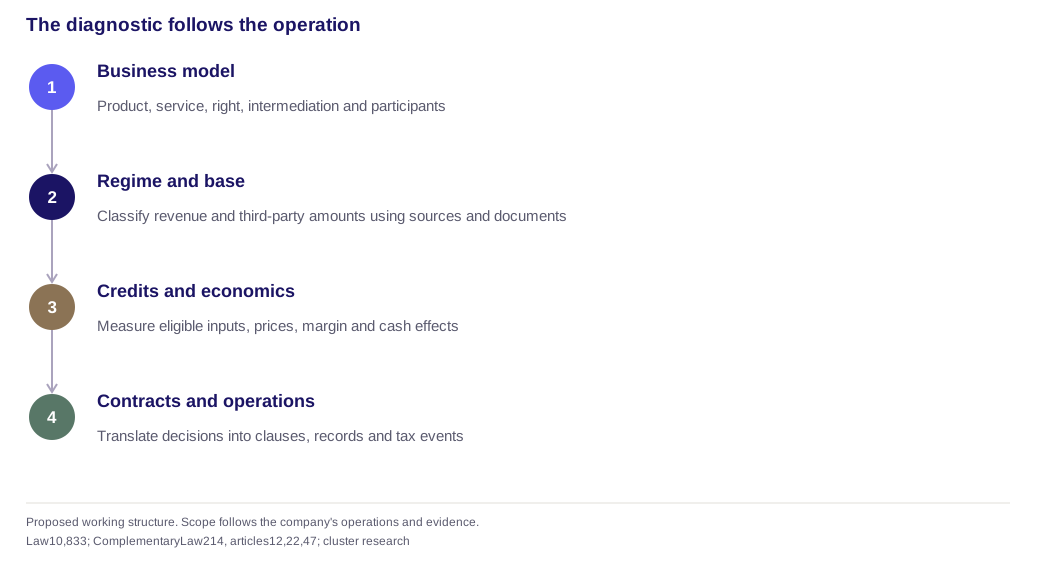
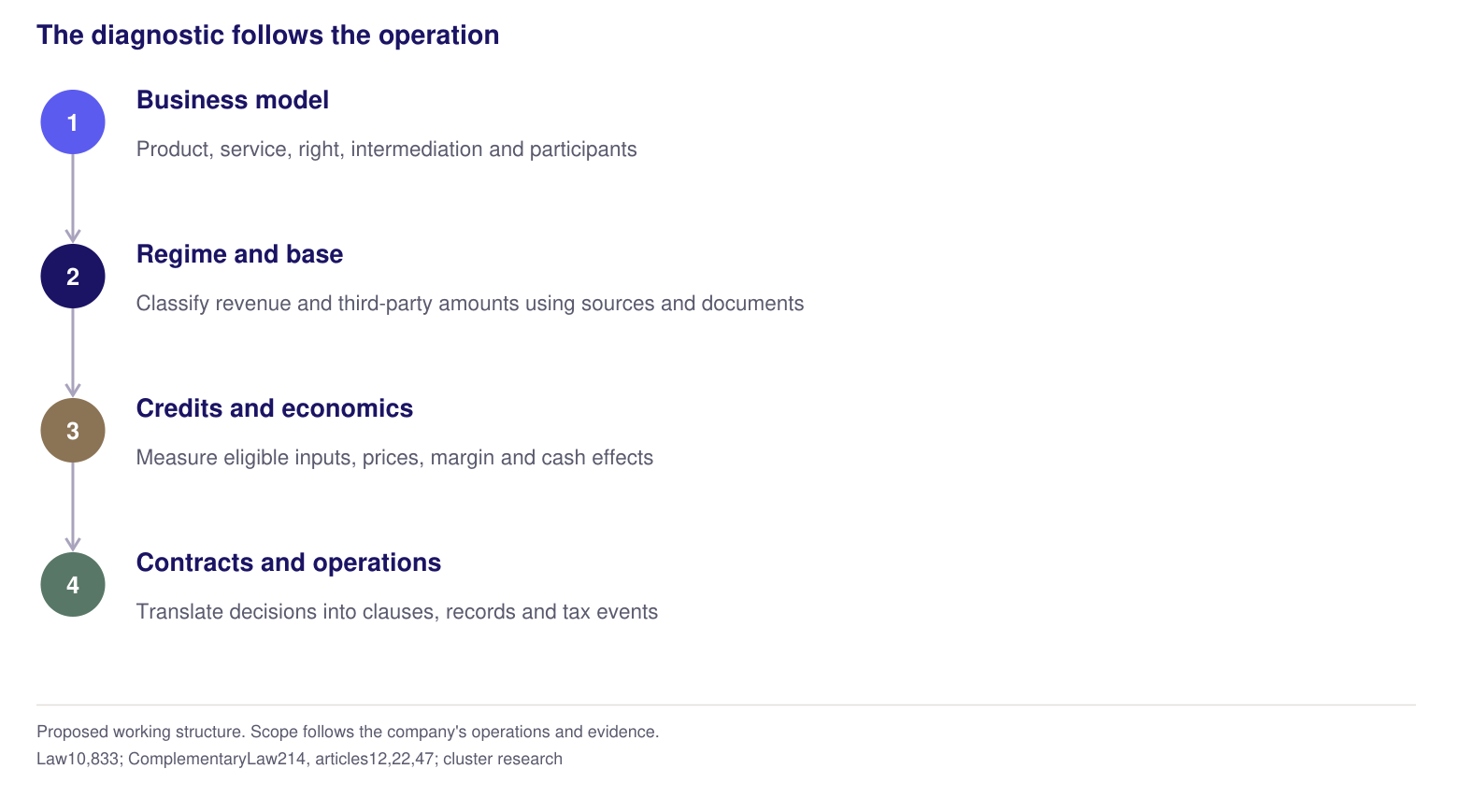
Tax consulting for technology: the diagnostic
The diagnostic starts with representative operations and the documents that explain them. Its purpose is to identify decisions relevant to the business and what is missing to support them. It does not assume that all companies in the sector have the same credits, risks or opportunities.
In the first stage, the TaxUp team organises products, contracts, legal entities, participants and financial flows. It then checks revenue classification, the tax base and credits against the documents and applicable rules. Articles 12 and 47, for example, require separating the analysis of third-party amounts from the analysis of acquisition credits. Complementary Law 214/2025.
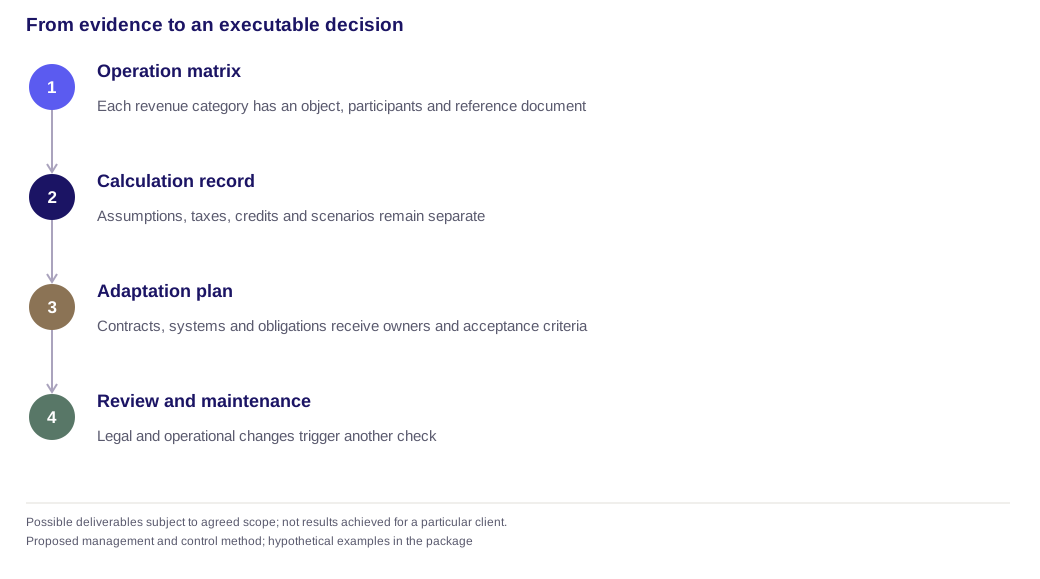
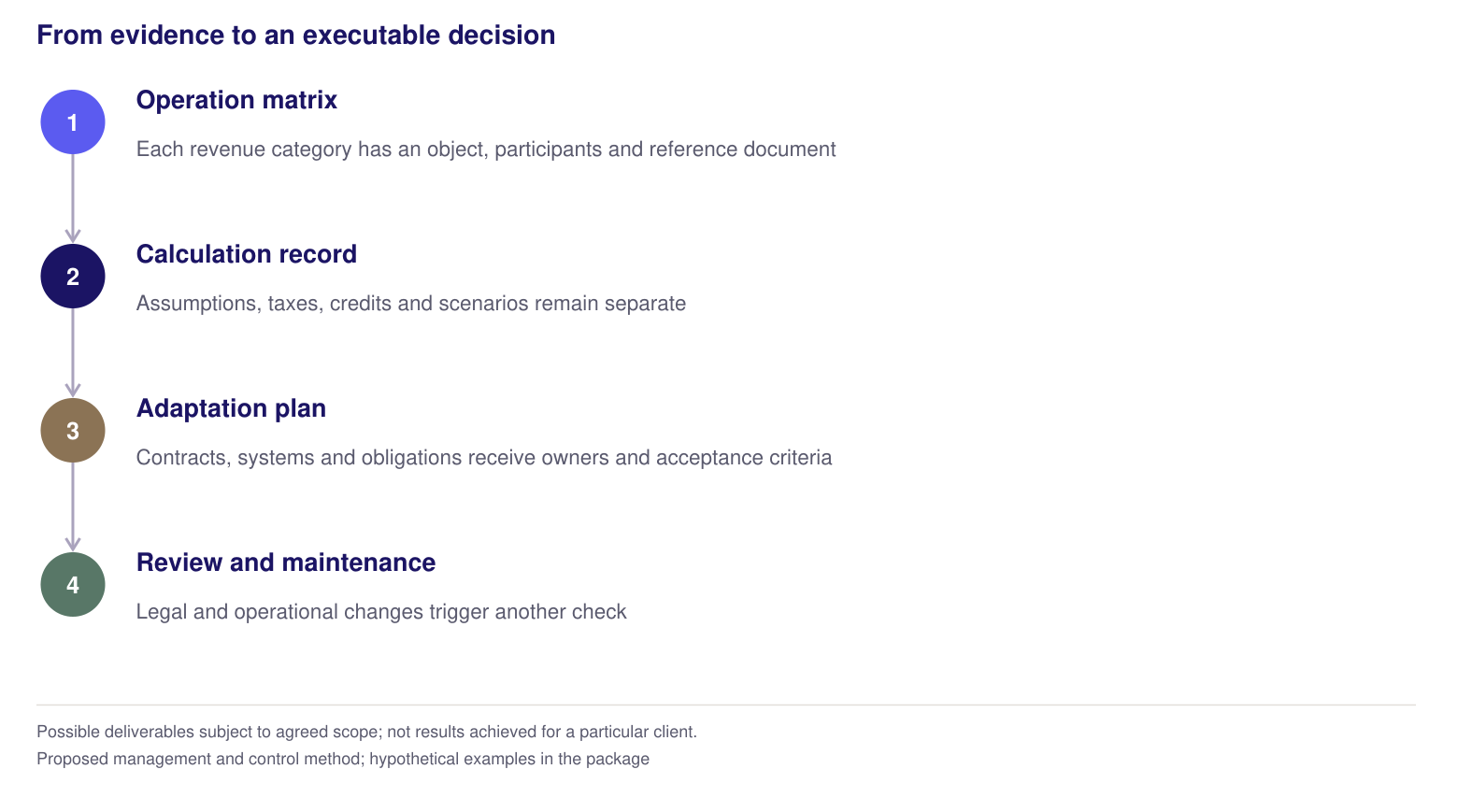
| Stage | Review deliverable | Decision it supports |
|---|---|---|
| Fact gathering | Inventory of operations, contracts and documents | Define scope and materiality |
| Classification | Matrix of regimes, bases, participants and requirements | Identify supported treatment and gaps |
| Modelling | Price, margin and cash scenarios with assumptions | Compare commercial alternatives |
| Adaptation | Contract, records, document and system plan | Assign owner, deadline and acceptance criteria |
| Validation | Reconciliation and decision record | Approve implementation and maintenance |
The report should classify conclusions as supported by available documents, conditional on additional information or subject to an identified controversy. That separation prevents a modelling assumption from being presented internally as approved treatment.
The company can start with the document checklist. The reform decision guide helps select priority operations; the digital operations matrix provides fictional cases to support that discussion.
Data sent for a specific review should be limited to what is necessary and handled through the agreed channel. No example in this collection reproduces information from a client or prospect.
Diagnostic boundaries
An IBS/CBS study does not replace analysis of corporate income taxes IRPJ and CSLL, innovation incentives or related-party transactions. The company may need parallel workstreams, but each requires its own legal basis, tax base, documents and conditions.
Brazil's Lei do Bem provides an example. Articles 17 and 19 of Law 11,196/2005 address incentives connected with technological research and innovation development; articles 22 and 23 add controls and conditions. Being a software business does not, by itself, establish an eligible activity or permit a benefit to be calculated on the entire engineering payroll. Nor does it turn an income-tax incentive into an IBS/CBS credit. Law 11,196/2005, articles 17, 19, 22 and 23.
| Area | Question requiring its own analysis | Limit of the connection with reform |
|---|---|---|
| Income-tax regime | Profit, adjustments and regime conditions | Does not independently determine PIS/Cofins or every consumption-tax credit |
| Innovation | Eligible activities, spending and controls | The incentive does not follow from the SaaS label |
| Foreign related parties | Functions, risks, contracts and prices | An on-behalf-of consumption arrangement does not resolve transfer pricing |
| Groups within minimum-tax rules | Perimeter, data and specific provisions | International growth alone does not establish that the group is in scope |
| Identified incentives or grants | Instrument, period and particular conditions | They are not presumed to apply to every technology business |
Where the transaction requires it, the engagement can connect transfer pricing and international tax advisory. The imported SaaS and cloud analysis provides a route to examining other taxes without merging them into the IBS/CBS calculation.
The diagnostic should identify when further analysis is needed, which information triggers it and who is responsible. This allows priorities to be set without promising one solution for taxes with different prerequisites.
Checklist
The checklist organises documents explaining the operation. There is no need to distribute the company's entire document collection indiscriminately: selection should reflect scope, period, materiality and authorised access. Copies for review should retain relevant content while limiting personal or commercial data that does not contribute to the analysis.
Download the editable English checklist in CSV.
| Category | Documents and information | Decision they help support |
|---|---|---|
| Offering structure | Product catalogue, components and billing models | Distinguish licensing, services and intermediation |
| Legal relationships | Customer contracts, terms of use and amendments | Identify obligations, acquirer and remuneration |
| Software and rights | Development contracts, licences, assignments and distribution | Classify own, third-party or imported software |
| Third-party amounts | Mandates, payment evidence, original documents and reconciliation | Examine on-behalf-of arrangements and acquisition ownership |
| Revenue and tax calculation | Trial balances, revenue accounts, invoices and tax records | Reconstruct regime and accrual timing by component |
| Purchases and credits | Tax documents, contracts and credit records | Check eligibility, amount and period |
| Employment and benefits | Relevant policies, contracts and collective instruments | Distinguish payroll, benefits and statutory exceptions |
| Platforms | Operating rules, records and payment flows | Examine control, liability and document issuance |
| International | Contracts, participants, destination and payments | Analyse imports, exports and related parties |
| Systems and transition | Records, versions, tests and calendar | Translate the conclusion into a verifiable tax process |
Article 12, paragraph 2, item IV, illustrates why a document in the third party's name can be decisive for reimbursements. Article 47, paragraph 1, item II, requires a valid electronic tax document for credit recognition. Bank evidence and a tax invoice perform different functions and should not be treated as automatic substitutes. Complementary Law 214/2025.
In the checklist, each item has an owner, acquisition status, location and notes. Suggested statuses are “to request”, “received”, “checked”, “insufficient” and “not applicable, with reasons”. Marking a file as received does not mean that legal analysis of its contents is complete.
A sample may help start the work, but it does not establish that the whole population is correct. If the conclusion requires reconciling all documents for a period, the report should state the universe, quantity checked and differences. That discipline is especially important for third-party amounts, mixed revenues and acquisition credits.
The intended result is evidence that allows the reasoning to be reproduced and missing information to be identified. It is not a general authorisation to transmit tax obligations, change contracts or make offsets. Those decisions follow the review and responsibilities defined in the diagnostic.
Frequently asked questions
Is the service only for companies that develop software?
The scope can also cover SaaS, resale, platforms, legaltech, outsourcing and other digital models. The analysis starts with the actual operation, not a shared commercial label.
Can the diagnostic be performed using total turnover alone?
The total helps assess materiality, but it does not establish the regime, tax base or credits. Contracts, revenue components, costs and documents are needed to support a conclusion.
Will every B2B customer be able to take a full IBS/CBS credit?
No. The acquirer's profile and statutory requirements must be checked. A buyer with a CNPJ, a bank, an investment fund and a Simples taxpayer should not be treated as one situation.
Does the engagement include reviewing contracts and the ERP?
Those areas can form part of the agreed scope, with defined deliverables and responsible people. Implementation should translate the legal conclusion into testable rules for documentation, tax calculations and controls.
Does a rate difference automatically identify recoverable amounts?
No. Recovery requires reconstruction of classification, tax calculations, credits, payments and the appropriate procedure. Economic simulation and an established legal right are different stages.
Define the scope of your tax diagnostic
The TaxUp team can organise the analysis around your operations, contracts and available tax information.
Talk to the team