
The reference is article 22 of Complementary Law 214, as amended by Complementary Law 227/2026. This analysis reflects sources reviewed through 30 August 2026.
Brazil digital platforms: identify the intermediated transaction
Map the supply before the intermediary
- Underlying transactionSupplier and acquirer roles should be established before the technology company’s conduct is classified.
- Coexisting revenuesOwn software licensing and third-party intermediation should remain separate in the transaction map.
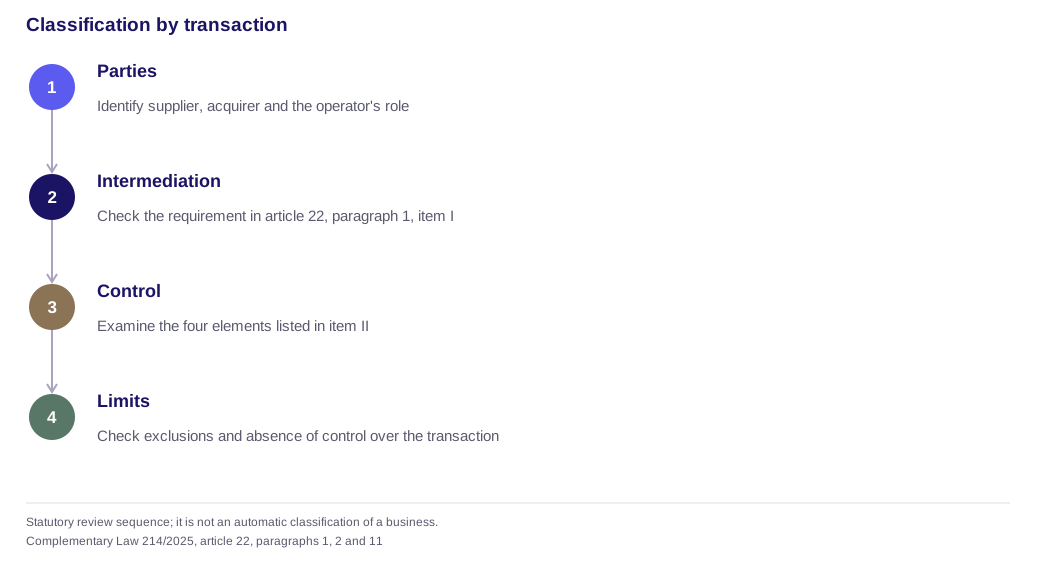
The contract needs to establish who supplies the goods or services and who acquires them. Only then does it make sense to ask what the technology company does between those parties. This sequence avoids treating a company that simply sells its own software online as an intermediary.
Consider a company licensing its system directly to a customer. It sets the subscription price, collects recurring fees and provides access to the software. Those controls concern its own sale. Without intermediation between a supplier and an acquirer, one of the requirements of article 22, paragraph 1, item I, is missing, even if the business is entirely digital.
The analysis changes if the same system starts connecting independent service providers with buyers and enables users to contract those third-party services. There is then an additional transaction to examine: the intermediated supply. Software licensing and intermediation may coexist, but they should not receive a single classification merely for customer-record convenience.
The review therefore starts with each revenue category and commercial process. The map of mixed software and consulting revenues (Portuguese) helps distinguish what the company supplies from what it enables between other parties.
Intermediation and control are cumulative requirements
| Legal element | Question to resolve | Useful evidence |
|---|---|---|
| Intermediation | Does the company connect a supplier and an acquirer through its activities? | Contracts, orders and identification of the parties |
| Billing | Who determines or conducts billing for the intermediated transaction? | Invoicing rules and collection communications |
| Payment | Who controls payment for that transaction? | Financial flows and available instructions |
| Terms and conditions | Who determines the conditions of the intermediated contract? | Accepted versions of the terms and authority to amend them |
| Delivery | Who controls delivery of the intermediated goods or services? | Acceptance, release, performance and handling of failures |
Article 22, paragraph 1, does not offer two independent alternatives. Item I addresses acting as intermediary in transactions and imports conducted remotely or electronically. Item II requires control over one or more elements expressly listed in the law.
This table is a proposed investigation framework, not a document list expressly imposed by statute. The legal test is in Complementary Law 214, article 22, paragraph 1, items I and II. Assessing the evidence depends on what each participant can actually decide and execute.
Not receiving the money, for example, addresses only part of the analysis. An operator may never handle the funds but still set essential contracting conditions or control delivery. Conversely, a screen labelled “payments” is insufficient: an administrative record may merely reflect decisions made entirely outside the system.
Contracts and product behaviour should describe the same operation
Reconcile terms, product and production records
- Substance over marketingClassification should reconstruct participants, service and control instead of importing a marketing category.
- Decision pointsEach stage should show who can accept, change, reject or complete the relevant act.
Terms of use describing the business as a mere technology provider do not conclude the analysis. If the product makes third-party contracting subject to rules determined by the operator, the documentation needs to explain the scope of that role.
The reverse also deserves attention. The word “marketplace” in marketing material does not, by itself, prove that article 22 is satisfied. Tax classification requires reconstructing the service, participants and control exercised, rather than passing a marketing category directly to the tax team.
A practical way to reconstruct the transaction is to follow it from supplier selection through completion. At each stage, record who can accept, change, reject or complete the act. Then compare that journey with the contracts and production records.
This work also supports partners’ tax registration records (Portuguese). An organised register helps document the transaction. A field marked “independent supplier”, however, cannot establish a relationship contradicted by the contracts and actual performance.
Examine the exclusions within their stated limits
Test each exclusion within its conditions
- Provider and serviceCommercial labels do not replace verification of the provider, authorisation and activity actually performed.
- Positive requirementsFailure to qualify for an exclusion does not itself prove platform status.
Article 22, paragraph 2, excludes persons performing only one of the activities it describes. These include internet access, payment services provided by institutions authorised by Brazil’s Central Bank, advertising, and supplier searches or comparisons. The last category carries a condition concerning remuneration based on sales.
The wording requires care. The payment exclusion cannot be applied to every company calling its product a gateway. The provider, its authorisation and the actual service must be checked. The remuneration condition attached to search and comparison services must not be omitted either.
Conversely, losing an exclusion does not remove the need to establish the positive requirements of paragraph 1. If a comparison tool starts charging on the basis of sales, that change calls for the full analysis. It does not automatically classify every transaction of the company.
The comparison of gateways, ERP, advertising and intermediation below develops those limits. It remains on the same page so that individual examples are not mistaken for a list of business categories that are invariably included or excluded.
One business may have transactions with different outcomes
| Hypothetical situation | Decisive question | Limited conclusion |
|---|---|---|
| Direct sale of the company’s own software licence | Is a third-party supply being intermediated? | Control over the company’s own sale is insufficient to establish intermediation |
| Electronic contracting with a third party under conditions set by the operator | Are there intermediation and control over the terms? | The facts may satisfy paragraph 1; exclusions and the full circumstances still require review |
| A third-party transaction entirely outside the company’s activities and control | Does the company control any element of that transaction? | Article 22 liability should not be extended automatically |
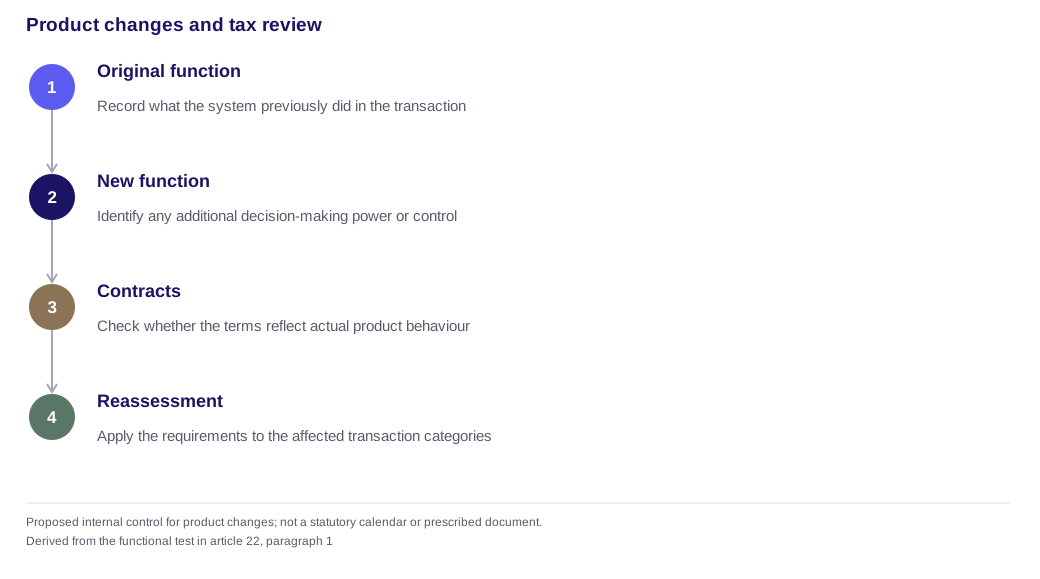
| A product changes from an administrative dashboard into a contracting environment | Does the new process change the operator’s role? | A new analysis is needed even if the commercial name remains unchanged |
Article 22, paragraph 11, provides that a platform is not liable under that article for transactions in which it controls none of the essential elements listed in paragraph 1, item II. The unit of analysis matters: a company-level classification should not be mechanically extended to every revenue stream or transaction.
These are educational hypotheticals, not classifications of actual companies. The third example does not rule out other potentially applicable grounds of liability or tax on the company’s own service.
The distinction is particularly useful for document outsourcing and legaltech businesses (Portuguese). A licence, a task performed by the company itself, engagement of a partner and payment on a customer’s behalf may appear within the same customer journey. Each portion depends on the documented arrangement.
Platform status does not determine the tax base or liability by itself
Classification, liability and own revenue
- Own-service baseThe tax base for the platform’s own service remains distinct from the supplier’s transaction.
- Other exclusionsPlatform status does not waive the conditions governing reimbursement treatment.
After classification, a second analysis begins. The opening provisions of article 22 distinguish foreign suppliers from suppliers resident or domiciled in Brazil. For the domestic route, the law takes into account, among other factors, information supplied by the platform and tax documentation for the transaction. The tax liability matrix (Portuguese) develops those situations.
The tax base of the platform’s own service is a separate question. A platform may earn a commission while also having obligations concerning tax on the supplier’s transaction. Liability for that tax does not automatically turn the entire intermediated amount into the platform’s own revenue. The reconciliation of commissions and transaction value (Portuguese) separates these amounts.
Similarly, excluding reimbursements for expenses incurred on behalf of third parties (Portuguese) requires examination of article 12, paragraph 2, item IV. Being a platform does not provide an alternative to satisfying the conditions of that exclusion. The two provisions address different issues and may both require analysis in one transaction.
Academic discussion of tax liability imposed on persons other than the primary taxpayer helps explain the distinction. Vanilson Pereira Santos examines this attribution to platforms in section 3.2 of a 2025 article, but the operative rule must be checked against subsequent legislation. Revista de Direito Tributário da APET, issue 52.
Read Complementary Law 227 and the regulations together
Current law, regulation and executable procedure
- Current textEarlier analyses need a fresh comparison with subsequent amendments before reuse.
- Operational availabilityUnderstanding the legal framework does not prove that an executable procedure is available.
Texts written before 2026 must be checked against the amendments. Paragraphs 8 and 9 of article 22 were repealed, and Complementary Law 227 added or changed relevant situations. An earlier protection should not be reused without checking whether it remains in force. Complementary Law 227/2026, articles 174 and 181.
The CBS and IBS regulations also address platforms. Article 20 of the consolidated Decree 12,955/2026 and the corresponding provision of CGIBS Resolution 6/2026 should accompany the analysis. The numbering of regulatory paragraphs does not fully reproduce the numbering in the law.
Understanding the legal framework also differs from having an executable procedure. Issuing documents in the supplier’s name (Portuguese) and the option to act as a substitute taxpayer (Portuguese) involve consent and their own rules. This article does not establish that a particular system is already authorised or technically equipped to exercise those options.
Organise the business-model review across teams
One transaction sample, distinct team lenses
- SampleA documented sample helps teams understand the process before reconciling the full population.
- DifferencesConflicts among product, legal and tax descriptions should become clarification tasks.
The review should bring legal, product and tax teams together around a documented sample of each transaction category. The sample is used to understand the process. The conclusion must then be reconciled with the full set of categories, so that no channel or contract remains outside the assessment.
Product describes the available functions. Legal reviews rights, obligations and decision-making powers. Tax checks the parties, documents, information and applicable regime. Differences between those three descriptions should generate a clarification task, rather than an automatic classification using the least burdensome alternative.
This work identifies which transactions need deeper review of liability, registration and document issuance. It does not replace checking Central Bank authorisation, interpreting an actual contract or validating the specific tax procedure. A tax advisory engagement for technology and SaaS should make those deliverables and limits clear from the outset.
Gateways, ERP, advertising and intermediation
| Observed function | Main legal test | Shortcut to avoid |
|---|---|---|
| Payment services only, provided by an authorised institution | Article 22, paragraph 2, item II, and actual scope | Treating “gateway” as proof of authorisation |
| Administrative recording of the customer’s own transactions | Intermediation and control under paragraph 1 | Treating every ERP as a platform or as an expressly excluded category |
| Advertising only | Article 22, paragraph 2, item III | Assuming any additional activity remains advertising |
| Search or comparison | Article 22, paragraph 2, item IV, including remuneration | Ignoring sales-based charges |
| Intermediated contracting with control over terms | Article 22, paragraph 1, and review of paragraph 2 | Deciding solely by the product label |
Exclusion from the digital platform definition depends on the service actually performed. Article 22, paragraph 2, describes specific activities and refers to performing only one of them. It does not justify assuming that every gateway is excluded, or that combining functions alone establishes the intermediation and control required by paragraph 1. Consolidated article 22.
Payment services authorised by Brazil’s Central Bank
Paragraph 2, item II, addresses payment services provided by institutions authorised to operate by Brazil’s Central Bank. A product’s commercial name does not establish the legal entity’s authorisation or show that its activities are confined to the specified service.
Consider two hypotheticals. In the first, an authorised institution provides only the payment service. That corresponds to the described statutory exclusion. In the second, an operator calls itself a gateway but also connects buyers and suppliers and determines the terms of their contract. That additional activity must be examined before invoking the exclusion.
Neither example classifies a real brand. The review must identify the service-providing entity, the applicable authorisation and the contracted service. Merely using an authorised payment partner does not automatically extend the exclusion to the platform’s entire operation.
ERP and administrative tools
ERP does not appear as an expressly named exclusion category in paragraph 2. The analysis of an administrative system instead checks whether it satisfies the positive requirements in paragraph 1.
A system recording invoices, reconciling receipts and executing its customer’s instructions may operate without intermediating third-party supplies. However, the label ERP may also cover contracting modules that connect parties and give the operator powers over the transaction. That module and its actual behaviour require examination.
Controlling the quality of the operator’s own software is not, by itself, equivalent to controlling delivery of every third-party supply recorded in it. The review should separate system administration from power over an intermediated transaction.
Advertising and supplier comparisons
Paragraph 2, item III, addresses advertising. Item IV describes supplier searches or comparisons and adds the condition that the service must not be charged for on the basis of sales made. A condition expressly attached to one item should not be moved to another without a legal basis.
A tool that only compares suppliers and is paid through a subscription unrelated to sales presents a situation compatible with item IV. If its charges become sales-dependent, that exclusion must be reassessed. Intermediation and the form of control must nevertheless still be established before concluding that paragraph 1 applies.
Record the conclusion without treating it as tax immunity
The review document should identify the product version, provider entity, transaction category and facts supporting the conclusion. This is a proposed control that helps identify when a commercial change requires classification to be revisited.
Even where a company is not a platform for that activity, its own service remains subject to the relevant tax rules. Article 22, paragraph 11, must also be read within its scope: transactions without control over the essential elements. It does not grant a general waiver of obligations. Complementary Law 214, articles 22 and 24.
Where the positive requirements are present, the next step is to apply the liability matrix (Portuguese) and review partner records (Portuguese). If the uncertainty arises from a functional system change, the ERP testing guide (Portuguese) helps translate the legal conclusion into documented checks.
Frequently asked questions
Common platform shortcuts tested
- Own SaaS saleSelling the company’s own software does not itself create intermediation of a third-party supply.
- Payment flowNot receiving funds does not settle whether other essential transaction elements are controlled.
Is every SaaS company a digital platform for IBS and CBS?
No. Article 22, paragraph 1, requires intermediation and control over an essential element of a remote or electronic transaction. Selling access to the company’s own software, without intermediating a third-party supply, does not by itself satisfy that combination.
Does not receiving the payment rule out platform status?
Not necessarily. Article 22, paragraph 1, item II, also includes billing, determining terms and conditions, and delivery. All relevant elements, together with intermediation, must be examined—not just whether money passes through the operator.
Can the terms of use declare that the business is not a platform?
The declaration forms part of the documentation, but it does not replace analysis of the functions and transactions. If actual operation differs from the contract, that inconsistency must be resolved before relying on the tax classification.
Is a platform liable for every transaction of its users?
That conclusion is too broad. Article 22 distinguishes situations of liability and, in paragraph 11, excludes transactions without control over the essential elements from its scope. Other legal grounds and the company’s own service remain subject to analysis.

Discuss a concrete case from your company
30 minutes with a senior consultant. We map your specific tax scenario, identify the applicable opportunities and indicate the technical path forward — whether or not you continue with us.
Book a free diagnostic 30 minutes with a senior consultant. No obligation.