
This analysis uses Complementary Law 214 as amended by Complementary Law 227/2026, articles 79–80. Sources were reviewed through 30 August 2026.
Brazil software exports: identify the supply being exported
Define the exported unit before testing relief
- SupplyThe review should identify the particular service, licence or deliverable sold abroad.
- Contractual unitThe agreement should let the business isolate the unit under analysis from adjacent supplies.
Article 79 grants immunity to exports of goods and services and addresses credits on related acquisitions, subject to the statutory conditions. Article 80 defines exports of services and intangible goods, including rights: a supply to a person resident or domiciled abroad, with consumption outside Brazil.
The first question is which supply is being exported. A developer may deliver a software component, license a complete product, implement a system or provide support. These four supplies may involve the same customer but different documents. The contract should make it possible to identify the unit being analysed.
I would separate the service sold by the Brazilian company from the customer’s subsequent use of the product. This does not permit disregarding recipients or consumption. It allows the correct part of the chain to be examined, without automatically attributing every downstream use to the original contracted supply.
That distinction should also appear in the SaaS contract and its statements of work (Portuguese). A general commitment to serve a global group may not adequately explain which entities receive each supply.
Why both the acquirer and the recipient matter
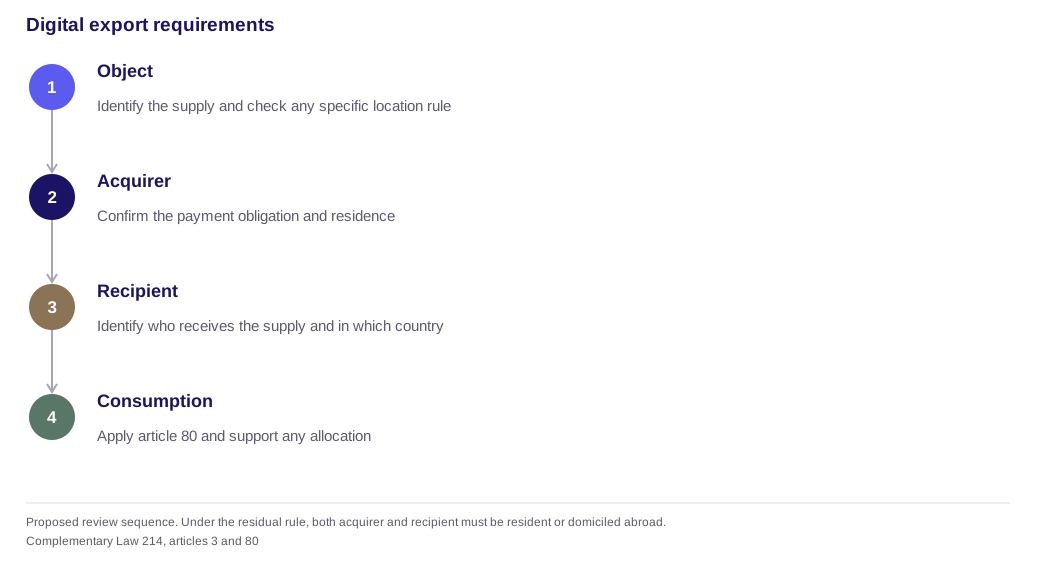
Article 80, paragraph 1-A, item II, treats consumption as occurring abroad in the residual category when both the acquirer and the recipient are resident or domiciled outside Brazil. Item I retains the specific location rules in article 11, items II–IX. The nature of the transaction must therefore be checked before applying the residual rule.
The acquirer is the person who assumes the obligation to pay for the transaction, subject to the rules for purchases on behalf of or in the name of another person. The recipient is the person who receives the supply. They may be the same person, but Complementary Law 214, article 3, items IV and V, recognises that they can differ.
A foreign parent may purchase software intended for its Brazilian subsidiary. In that situation, the acquirer’s country does not settle the export question. The Brazilian entity receiving the supply must be included in the analysis.
Nor does a failed export test turn a Brazilian provider into a foreign supplier. The transaction and its location must be examined on their own facts. An import under article 64 requires a supplier resident or domiciled abroad. The guide to imported SaaS and cloud addresses that different supply chain.
Four scenarios for sales and finance teams to distinguish
| Hypothetical situation | Decisive question | Evidence to obtain |
|---|---|---|
| A foreign customer purchases for itself and is also the recipient abroad | Does the residual supply satisfy both sides of article 80? | Contract, residence information and delivery scope |
| A foreign parent purchases for a Brazilian entity | Who actually receives the supply? | Local order, licence and identification of the entity served |
| A foreign company merely pays the Brazilian acquirer’s obligation | Does the payment change the legal acquirer? | Contractual payment obligation and third-party payment arrangement |
| A supply has Brazilian and foreign portions | Can the portions be legally identified and supported? | Separate scope, recipients and allocation record |
These scenarios are illustrative, not conclusions about actual businesses. They show which information must reach the tax team before invoicing.
It is also necessary to distinguish the recipient from individual users. An employee may travel, use a virtual private network or access a server in another country. Such information may contribute to the evidence, but it does not replace identification of the legal acquirer and recipient or independently establish an export.
The guide to the destination of digital services (Portuguese) develops the rules on domicile, registration and establishments. It helps prevent a commercial field labelled “billing country” from determining the tax result without legal validation.
Mixed consumption requires a defensible allocation record
Allocation needs a reason, measure and record
- Measurement choiceA convenient billing metric is not automatically the legally appropriate allocation measure.
- Audit trailRule, recipients, measurement unit, supporting documents and changes should remain documented.
Article 80, paragraph 5, provides that where a supply takes place simultaneously in Brazil and abroad, only the portion performed or consumed abroad is treated as an export. This provision must be read together with the main rule and paragraph 1-A. Complementary Law 214, article 80.
An allocation based on user numbers may be convenient for billing. Convenience does not make it the legally correct measure. The company needs to explain what is being supplied, to whom, and why the division represents those supplies or portions.
A contract identifying particular entities, separate prices and demonstrable deliveries provides material for that analysis. A single global invoice accompanied only by an access list may leave the proposed allocation unsupported. Contractual wording must also reflect actual operations: a formal division created for billing does not, by itself, establish consumption.
The allocation record should identify the legal rule used, the recipients, the chosen measurement unit, the supporting documents and the reason for any changes. The provisions discussed here do not support presenting a fixed country percentage as a universal solution.
Current ISS and PIS/Cofins rules apply different tests
| Regime | Central test in this analysis | Assumption to avoid |
|---|---|---|
| Current ISS | The result of the service, assessed on the facts | Treating foreign currency as sufficient export evidence |
| Current PIS/Cofins | Supply to a foreign customer and the financial requirement, with the statutory exception for funds retained abroad | Requiring an actual inflow in every situation |
| IBS/CBS | Supply to a person resident or domiciled abroad and consumption abroad under article 80 | Automatically importing the ISS or PIS/Cofins tests |
Under the current system, Brazil’s municipal services tax, ISS, requires attention to the result of the service. Article 2 of Complementary Law 116 excludes services developed in Brazil whose result occurs in Brazil from the export relief, even where a foreign resident makes the payment. The payment country does not settle that test. Complementary Law 116, article 2, item I and sole paragraph.
For PIS/Cofins, article 5, item II, of Law 10,637 and article 6, item II, of Law 10,833 address services supplied to a foreign resident or domiciliary where payment represents an inflow of foreign currency. Article 14 of Provisional Measure 2,158-35 contains relevant provisions depending on the applicable regime. Law 10,637, Law 10,833 and Provisional Measure 2,158-35.
A qualification changes the financial advice: article 10 of Law 11,371 permits the specified relief without an actual inflow where the company retains the funds abroad in accordance with article 1. It would therefore be inaccurate to recommend that every export receipt must pass through a Brazilian account. The retention must satisfy the legal conditions and be documented. Law 11,371, articles 1 and 10.
The technology and SaaS tax reform guide should be read with the relevant period in mind. Article 542 of Complementary Law 214 provides for repeal of the relevant PIS/Cofins provisions in 2027. Complementary Law 116 follows its own transition, with repeal scheduled for 2033. Evidence for revenue earned in 2026 should not be organised as if every rule of the final system had already replaced the current one.
What the STJ software decision actually establishes
Read the judgment within its factual limits
- What it illustratesThe decision shows why the supply and its supporting facts need to be defined.
- What it does not decideThe judgment does not create automatic export relief for every foreign software customer.
In AgInt no AREsp 1,720,081/SP, the First Panel of Brazil’s Superior Court of Justice, with Justice Sérgio Kukina as reporting judge, dismissed the internal appeal in a judgment concluded on 15 March 2021 and published on 18 March 2021. The municipality sought to overturn the recognition of an export of software services. Official full judgment.
The opinion reproduces the lower court’s finding, supported by expert evidence, that components developed in Brazil required integration with other components abroad to produce the contracted result. Reversing that finding would require a reassessment of facts and contracts, barred by the court’s Precedent Statements 5 and 7.
For a business review, the case illustrates the importance of defining the supply and proving the facts. It does not establish an abstract rule that every software sale to a foreign customer is a tax-relieved export. It is also not a decision on article 80 of Complementary Law 214.
In an actual transaction file, the contract and invoices should be consistent with deliverables, acceptance and performance. Citing this judgment without explaining its procedural limits would create a degree of assurance that the decision does not provide.
Export immunity does not remove documentation or guarantee immediate cash
The right to retain and use acquisition credits connected with an export follows article 79 and the provisions to which it refers. Recognising a credit, offsetting it in the tax calculation and obtaining a refund are different steps. An immune sale can coexist with cash outflows in the acquisition chain.
Planning should therefore identify which purchases generate credits, when those credits may be recognised and how they can be used. The review of technology expenses and credits (Portuguese) and the conditions for financial credits (Portuguese) examine those questions.
Tax documentation also requires analysis. Article 115, item I, of the CBS Regulation extends to transactions enjoying immunity, exemption, a zero rate or suspension. Revenue immunity is therefore not an automatic exemption from issuing a tax document. Decree 12,955/2026, article 115.
General document start dates differ under Joint RFB/CGIBS Act 4/2026. The start of a relevant new obligation must not be confused with municipal documentation already required. Before changing invoicing, the tax team should confirm the classification, applicable document and period. Joint Act 4, article 1.
Build the evidence file before the first invoice
Evidence file for the first invoice
- PartiesCustomer records should distinguish the legal acquirer and recipient from a foreign commercial contact.
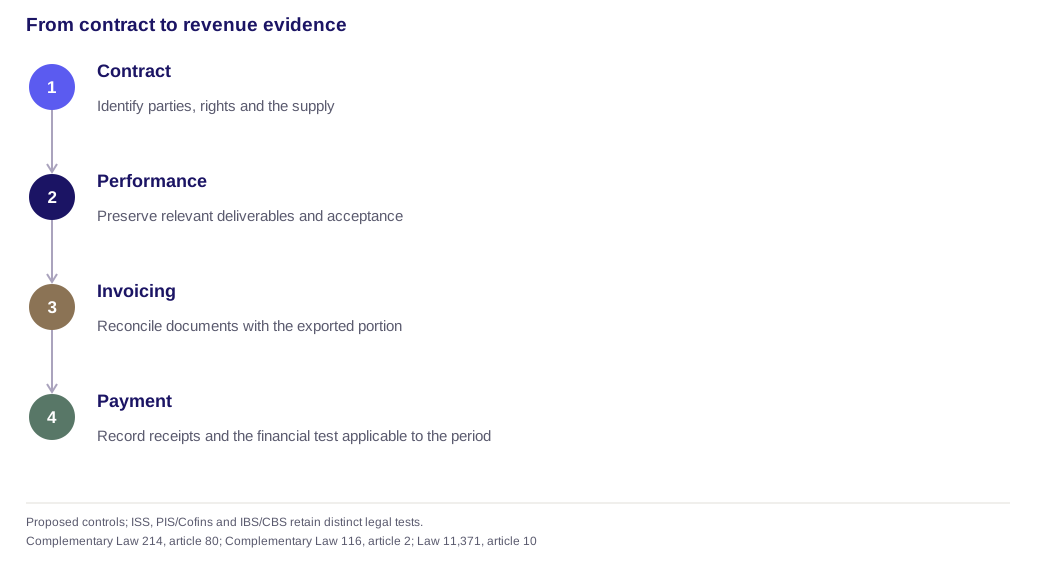
- ReconciliationInvoice, tax document and payment should align with the contract and performance evidence.
Customer records should identify the acquirer and recipient for each transaction, rather than merely list a commercial contact abroad. The contract should enable the company to establish who receives the software or service and who assumes the payment obligation.
Next, assemble evidence of performance and acceptance that is relevant to the contractual object: deliverables, local orders, implementation records and the scope of the entities served. Technical data is useful when it answers the legal question. Accumulating logs unrelated to the conclusion may enlarge the file without improving the evidence.
The commercial invoice, tax document and payment should be reconciled with that material. For periods in which the PIS/Cofins financial requirement matters, record the inflow or retention of funds and the legal basis used. If there is a Brazilian portion, show its treatment instead of concealing it within global revenue.
A review by a tax advisory team for technology and SaaS should deliver the conclusion, its assumptions and the documents still needed. Classification should be reassessed when the recipient, supply or contracting model changes.
Frequently asked questions
Commercial signals versus export conditions
- Foreign currencyReceiving foreign currency does not independently establish the destination of consumption.
- Brazilian recipientA foreign parent’s contract does not settle the treatment when a Brazilian entity receives the supply.
Does receiving US dollars prove a software export for IBS/CBS?
No. Article 80 requires a supply to a foreign resident or domiciliary and consumption abroad. Under the residual rule, both the acquirer and recipient must be resident or domiciled abroad. Currency and the receiving account alone do not establish those conditions.
Does a contract with a foreign parent cover use by its Brazilian subsidiary?
The contract must be examined. If the Brazilian subsidiary receives the supply, the acquirer’s foreign residence alone does not satisfy article 80, paragraph 1-A, item II. There may be distinct supplies or portions, which must be identified and supported.
Must all export revenue enter a Brazilian account?
That statement is too broad. Under the current PIS/Cofins system, article 10 of Law 11,371 addresses funds retained abroad under article 1 and removes the need for an actual inflow for the specified relief. The transaction and relevant period must be documented.
Does the STJ decision guarantee relief for every SaaS export?
No. AgInt no AREsp 1,720,081/SP preserved the lower court’s factual conclusion because of restrictions on reviewing facts and contracts. It demonstrates the importance of evidence in that ISS case and does not decide SaaS exports generally or the new IBS/CBS regime.

Discuss a concrete case from your company
30 minutes with a senior consultant. We map your specific tax scenario, identify the applicable opportunities and indicate the technical path forward — whether or not you continue with us.
Book a free diagnostic 30 minutes with a senior consultant. No obligation.