
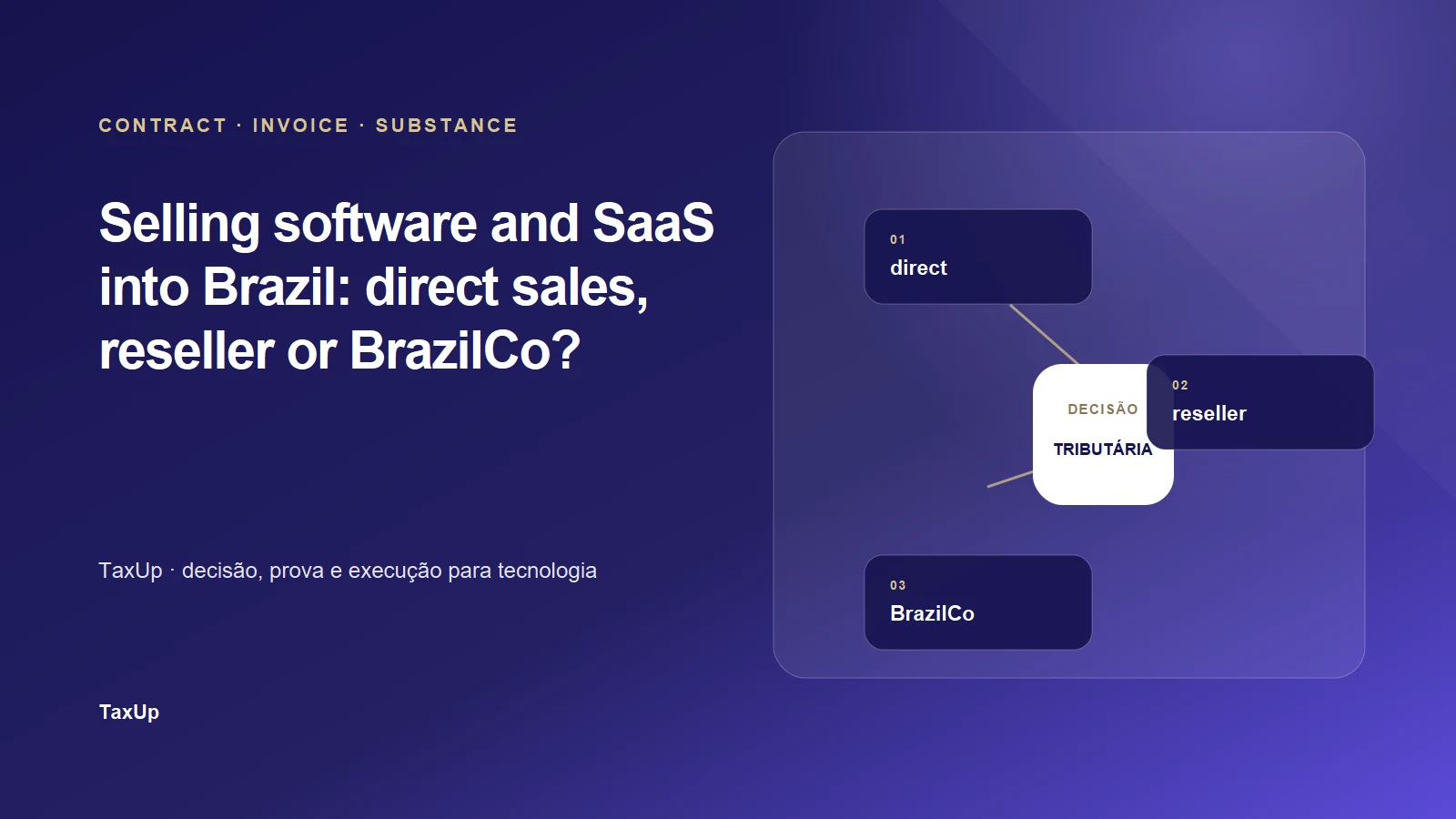
Under arts. 21 to 23 of LC 214/2025, there is no universally best route for selling software into Brazil. Direct remote sales preserve control but require cross-border collection and foreign-supplier compliance; a reseller localises billing but needs genuine distribution functions; BrazilCo adds fixed compliance and related-party flows but can support local invoicing, people and long-term control.
A decision guide for foreign software suppliers comparing remote sales, a Brazilian reseller and a local company across contracts, invoicing, tax, credits and operating substance.
There is no universally best route for selling software into Brazil. Direct remote sales preserve control and price, but require cross-border collection, customer gross-up and foreign-supplier IBS/CBS duties to be designed. A reseller localises billing and selected functions, but charges a margin and must actually hold distribution rights. A Brazilian company — a BrazilCo — adds fixed compliance and related-party flows, but can support local invoicing, people and long-term control.
The comparison should therefore begin with the customer contract, not a headline tax rate. The decision-maker needs to identify what is supplied, who buys it, who invoices, who collects, whether the Brazilian customer can claim consumption-tax credits and which entity performs the work in practice.
This guide owns that route decision. For the broader entity and incorporation roadmap, use TaxUp’s expanding to Brazil guide. For the import mechanics viewed from the Brazilian customer’s side, use the Brazil IBS/CBS guide for imported SaaS and cloud.
The decision in one view
| route | customer contract and invoice | principal commercial advantage | principal decision risk |
|---|---|---|---|
| direct remote sale | foreign supplier contracts and invoices the Brazilian customer | control of price, product and customer relationship | collection, gross-up, local procurement friction and foreign-supplier compliance |
| reseller/distributor | Brazilian reseller normally contracts with and invoices the customer | local invoice, channel access and localised collection/support | margin, loss of control and a contract that does not match actual distribution functions |
| BrazilCo | Brazilian entity contracts with and invoices the customer | local operating control, people, invoice and customer ownership | fixed compliance, capital, domestic tax and related-party flows |
A referral agent and a reseller are not interchangeable. A platform or Merchant of Record is not automatically a fourth corporate route. Those distinctions determine which party remains the supplier, which payment crosses the border and which evidence must support the tax result.
The first practical test is not “which rate is lower?” It is:
- Can Brazilian customers contract with and pay the foreign supplier without losing deals or demanding a gross-up?
- Does a reseller create enough conversion, collection and support value to justify its margin?
- Does the value of local invoicing, personnel and control justify the cost and risk of BrazilCo?
Classify what is actually being sold
“SaaS” is a product description, not a complete Brazilian tax classification. One commercial package can include several legally relevant components:
- an end-user software licence;
- access to a hosted platform;
- a commercialisation or distribution right;
- implementation and data migration;
- custom development;
- support, training or consulting;
- source-code, know-how or another technology-transfer element;
- payment, marketplace or advertising functions.
The Brazilian Software Law, art. 9 states that software use in Brazil is governed by a licence agreement. Article 10 requires agreements for commercialisation rights in foreign software to allocate taxes and charges and establish the foreign right holder’s remuneration. Article 11 uses technical absorption material — including commented source code and functional specifications — to distinguish technology transfer.
That classification changes the route analysis. The Brazilian tax authority treated an end-user licence in SC Cosit 107/2023 differently from the distribution/commercialisation facts examined in SC Cosit 177/2024. The second ruling cannot be converted into a blanket exemption for any agreement labelled “reseller”.
Before comparing structures, prepare a component map showing the right, service, price, contracting party, performer and evidence for every material line of the offer.
Route 1: direct remote sales
In a direct route, the foreign supplier keeps the Brazilian customer contract and normally issues the foreign invoice. The Brazilian customer makes a cross-border payment. Product control is high and a distributor margin is avoided, but the supplier must design the landed customer experience rather than assume the buyer will solve it.
Direct B2B sales
Direct B2B can work when customers are prepared to procure from abroad, process the import/remittance requirements and accept the contract’s gross-up allocation. It is usually easier to validate when:
- the number of Brazilian customers is limited;
- average contract value is high;
- customers have mature tax, legal and FX functions;
- local-currency invoicing is not a buying requirement;
- implementation and support can be delivered remotely;
- the supplier does not give local personnel authority inconsistent with the remote model.
The customer type matters. A regular-regime buyer may be sensitive not only to nominal tax, but to whether it can claim an IBS/CBS credit. Under LC 214/2025, art. 64, § 5, VII, a regular-regime buyer may appropriate and use credit under the general rules. A direct import therefore does not automatically strand the credit. The actual buyer, document, payment and statutory conditions still need to be tested.
Direct B2C sales
B2C requires a different operating model. An individual customer generally cannot absorb import tax and documentation work like a large enterprise. Pricing, customer location, collection, refunds, chargebacks, consumer support and data protection become central.
The new consumption-tax framework also reaches foreign suppliers. LC 214/2025, art. 21, § 2 requires a foreign supplier to register as a taxpayer for operations in Brazil or as a responsible party for imports, subject to the place rules and art. 23. Imported services and intangible goods are tied to consumption in Brazil under art. 64.
This does not mean that every current portal step should be assumed live and final. Registration, fiscal-document and reporting procedures must be rechecked before launch. It does mean that “the customer pays everything” is not a durable supplier-side strategy.
Current remittance and import layer
Until the transition replaces the current consumption taxes, the payment may require analysis of:
- IRRF, including the payment’s legal nature and any applicable treaty;
- CIDE, including the specific software exception and any technology/service component;
- PIS/Cofins-import, including the service and result-in-Brazil analysis;
- ISS on imported services and the municipality’s collection mechanics;
- FX documents and the contract’s gross-up or tax-allocation clause.
For example, Law 10,865/2004, art. 1, § 1 reaches foreign services executed in Brazil or whose result occurs in Brazil. LC 116/2003, arts. 1, § 1 and 6, § 2, I address imported services and assign responsibility to the Brazilian recipient or intermediary. These are legal gates, not a universal percentage for every software contract.
Route 2: reseller or distributor
A reseller can convert the foreign supplier’s cross-border sale into two different legs:
- the foreign supplier grants the Brazilian reseller the actual rights and support needed for distribution; and
- the Brazilian reseller contracts with and invoices the end customer.
This can solve local invoice, currency, procurement, collection and first-line support requirements. It can also accelerate channel access. The price is the reseller’s discount or margin, lower direct customer control and the need to govern brand, data, service levels and renewal ownership.
The agreement must create a real distribution model
A “reseller agreement” that leaves every customer contract, price, invoice and collection with the foreign supplier may be an agency/referral arrangement in substance. Conversely, a distributor that buys a defined commercialisation right, sets or applies permitted local commercial terms, invoices customers and bears agreed market functions has a different fact pattern.
The following must reconcile:
- right acquired by the Brazilian company;
- permission to market, sublicense or resell;
- end-customer terms;
- price and discount/margin;
- invoice issuer;
- payment and FX flow;
- support and warranty obligations;
- customer and usage data;
- refund, bad-debt and chargeback risk;
- source-code or technology access;
- actual conduct.
SC Cosit 177/2024 examined commercialisation/distribution of a cloud platform without source-code transfer and reached conclusions different from the end-user licence in SC 107. The lesson is not “distribution is tax-free”. The lesson is that the right acquired and the facts performed matter.
Margin is only one row
The distributor margin should be compared with functions actually transferred. If the foreign supplier still provides all sales engineering, contracting, billing, collections, implementation, support and credit risk, a large local margin may be commercially and, for related parties, transfer-pricing sensitive.
If the reseller is related to the foreign supplier, Law 14,596/2023 requires controlled terms to follow the arm’s-length principle. TaxUp’s Brazil transfer-pricing guide covers that broader system.
Agent, platform and Merchant of Record are different layers
Referral or sales agent
An agent may identify prospects, support negotiations or earn a commission while the foreign supplier remains the contracting and invoicing party. The agency agreement must define authority, exclusivity, use of brand, customer data and whether the agent can bind or routinely conclude contracts.
The deeper principal-versus-agent guide explains why revenue presentation and tax base depend on actual control and role, not the label “partner”.
Platform or Merchant of Record
A platform/MoR may become the disclosed merchant, process local methods, manage indirect-tax collection, issue documents or handle refunds. But it does not automatically create a subsidiary or convert every supply into a distribution arrangement.
For IBS/CBS, LC 214/2025, art. 22 defines a digital platform as an intermediary that controls at least one essential element: collection, payment, terms and conditions, or delivery. Payment services alone, advertising and qualifying search/comparison activities are excluded. A foreign supplier operating exclusively through a registered regular-regime platform can be excused from its own registration under § 3, subject to the statutory conditions.
The diligence must therefore ask:
- who is named as supplier to the customer;
- who controls terms, price, collection and refund;
- who invoices;
- who has the customer funds and when;
- which entity reports the transaction;
- whether the provider is registered under the applicable Brazilian regime;
- what remains the software supplier’s own obligation.
TaxUp’s platform commission guide examines a separate but related question: whether the platform acts as principal or intermediary and how the gross amount and commission should be treated.
Route 3: a Brazilian company
BrazilCo places the local customer sale in a Brazilian resident company. It can invoice locally, hire people, contract with local suppliers, collect in local currency and own the Brazilian customer relationship. It also creates an ongoing corporate, accounting, payroll and tax perimeter.
It should be tested when one or more of these conditions become material:
- enterprise procurement requires a Brazilian vendor and fiscal document;
- local currency and payment methods materially improve conversion or collection;
- a local sales/customer-success team needs real authority;
- the reseller margin exceeds the cost of building and controlling the local operation;
- regulatory, data, service-level or contracting needs require local accountability;
- Brazil has moved from market validation to a durable operating region.
BrazilCo does not remove the cross-border layer
The local company may pay its foreign group for software rights, support, services, financing or other functions. Related cross-border transactions can enter Brazil’s transfer-pricing rules under Law 14,596. Those payments also retain their own withholding and import-tax analysis.
Profit repatriation is another row. Law 15,270/2025 amended Law 9,249 so dividends remitted abroad are generally subject to 10% IRRF, with statutory exceptions and a credit mechanism when the combined effective burden exceeds the legal benchmark. A model that compares direct sales with BrazilCo but omits repatriation is incomplete.
Foreign investment also requires implementation. The Central Bank’s foreign-capital reporting page identifies SCE-IED and the current manual for direct investment. Capitalisation, shareholder documents, FX and beneficial-owner records should be part of the launch plan.
Subsidiary and foreign branch are not the same
A BrazilCo is normally a Brazilian entity owned by the foreign group. A foreign branch is the foreign company itself operating through an authorised establishment. Civil Code art. 1,134 states that a foreign company may not function in Brazil without Executive authorisation. DREI guidance provides the prior-authorisation process for a branch, agency, office or establishment.
This guide does not choose a corporate form. It marks the boundary so that a board does not call every local presence “BrazilCo” or every remote sale a branch.
Current taxes and the IBS/CBS transition
Brazil’s route model needs two time layers.
The current layer
The current payment may involve IRRF, CIDE, PIS/Cofins-import and ISS. Their application depends on the classified right or service, payer, payee jurisdiction, treaty, technology-transfer facts, result in Brazil, municipal law and contract.
For software, Law 10,168/2000, art. 2, § 1-A excludes remuneration for software use and commercialisation/distribution rights from CIDE unless the corresponding technology is transferred. A service or technology component must still be analysed separately. A blended invoice should not be turned into one label merely because that produces the preferred answer.
The IBS/CBS layer
LC 214 adopts a destination-based model for imported services and intangible goods:
- foreign consumption in Brazil can be an import under art. 64;
- the Brazilian buyer is taxpayer, or the recipient if the buyer is abroad;
- the foreign supplier can be jointly liable and subject to registration;
- a qualifying platform can be responsible;
- a regular-regime buyer can claim credit under the general rules;
- if the foreign supplier/platform is not registered, art. 23 provides collection through the FX institution at reference rates and settlement of differences by the buyer/importer.
The transition must not be presented as one steady-state percentage. In 2026, arts. 343 and 346 provide nominal rates of 0.1% IBS and 0.9% CBS. Article 348, § 1 waives payment for subjects that comply with the relevant accessory obligations. The applicable rules and rates for the launch year must be checked at that time.
Compare the economics with a reconciled model
Consider a foreign SaaS supplier expecting R$ 12 million in annual Brazilian customer billings. The following assumptions are illustrative, not market benchmarks:
- direct collection, FX and chargeback cost: 3%;
- distributor discount/margin: 35%;
- BrazilCo annual local operating cost: R$ 2.4 million;
- tax, gross-up, credit, capital and working-capital rows remain open.
| route | reconciliation | contribution before tax/open rows |
|---|---|---|
| direct remote | R$ 12.0m − R$ 0.36m | R$ 11.64m |
| distributor | R$ 12.0m − R$ 4.20m | R$ 7.80m |
| BrazilCo | R$ 12.0m − R$ 2.40m | R$ 9.60m |
The distributor margin exceeds the assumed BrazilCo operating cost by R$ 1.8 million. That is not yet a saving. BrazilCo still needs domestic corporate tax, payroll, compliance, capital, related-party flows, transfer pricing and repatriation. Direct remote still needs current remittance/import taxes, contract gross-up, buyer-credit, registration and collection rows.
The model becomes decision-grade only after adding:
- B2B/B2C and buyer-regime mix;
- deal loss or price uplift caused by foreign invoicing;
- route-specific gross-up;
- credit availability and timing;
- support and implementation cost;
- reseller functions and customer ownership;
- local payroll and professional fees;
- intercompany rights, services and funding;
- collection days, bad debt and FX;
- exit or migration cost.
When remote selling needs a local-presence review
Remote sale alone does not answer whether a foreign company is functioning in Brazil or has a treaty permanent establishment. The risk changes when operating facts change.
Review the model if Brazil has:
- employees or contractors working mainly for the foreign supplier;
- a fixed place, office or recurring premises;
- a person with authority to negotiate or conclude contracts;
- habitual local delivery, implementation or management;
- inventory or hardware operations connected to the software offer;
- an “independent” partner whose conduct is controlled like an internal team;
- a country treaty whose permanent-establishment article may apply.
Civil Code, corporate authorisation, labour/payroll, treaty and tax presence are related but distinct questions. The conclusion must use the actual people, place, authority and conduct, not a remote-work slogan.
Contract, data, payment and evidence checklist
Contract and offer
- software/right and service components separated;
- customer, user and recipient identified;
- contracting party consistent across order form and terms;
- taxes, withholding, gross-up and proof of payment allocated;
- reseller authority and distribution rights explicit;
- platform/MoR role disclosed;
- price, discount, commission and refunds documented;
- support, warranty, implementation and data duties allocated.
Payment and tax data
- invoice issuer and currency;
- collection provider and settlement entity;
- FX/remittance documents;
- customer location and tax status;
- buyer and recipient identifiers;
- tax document and registration status;
- credit support for the Brazilian buyer;
- reconciliation from gross customer amount to foreign receipt.
People and substance
- organisation chart and reporting lines;
- sales and contracting authority matrix;
- reseller or agent independence;
- location of implementation and support;
- local premises and equipment;
- board-approved entry model and review trigger.
Data protection
LGPD art. 3 can apply when processing targets the offer or supply of goods or services to individuals in Brazil, regardless of the company’s home country. Article 33 restricts international data transfers to the listed routes and safeguards. Map controllers, processors, hosting, support access, sub-processors and transfer mechanism for every route.
Decision gates
Direct remote is a candidate when
- the business is still validating the market;
- customers can procure cross-border;
- local invoice does not decide the sale;
- collection and support work remotely;
- the supplier can operate the foreign-registration and documentation requirements;
- local people do not contradict the chosen model.
A reseller is a candidate when
- local invoice, collection or channel access materially improves sales;
- the partner assumes real distribution functions;
- its margin is supported by those functions and risks;
- customer ownership and data access are acceptable;
- the foreign payment is correctly classified and documented;
- the arrangement can be changed if Brazil reaches scale.
BrazilCo is a candidate when
- Brazil is a durable operating market rather than a test;
- local contracting and people materially improve contribution;
- customer control is worth the fixed perimeter;
- the intercompany and capital model can be documented;
- the local compliance organisation is ready;
- the board has quantified transition and exit cost.
The decision should be reviewed at defined triggers — for example customer concentration, recurring local headcount, reseller-margin amount, procurement losses or a change in IBS/CBS year — rather than once per vague annual planning cycle.
Frequently asked questions
Does a foreign SaaS supplier have to open a company in Brazil?
Not automatically. Direct remote sales and platform/reseller models can exist. The decision depends on customer procurement, collection, people, authority, sector regulation and the foreign-supplier obligations under the tax-reform framework. A foreign company that actually functions through a Brazilian establishment raises a different corporate-authorisation question.
Does a foreign supplier have to register for IBS/CBS?
LC 214, art. 21, § 2 creates a registration duty for foreign suppliers carrying out operations in Brazil or acting as responsible parties on imports, subject to the place rules and art. 23. Exclusive use of a qualifying registered platform can change the supplier’s registration position under art. 22, § 3. Recheck the live procedure before implementation.
Is a reseller the same as a sales agent?
No. An agent may introduce or support the customer while the foreign supplier remains the contracting and invoicing party. A reseller normally acquires commercialisation/distribution rights and invoices the end customer. Contract and conduct must agree.
Is a Merchant of Record the same as BrazilCo?
No. A MoR is a contractual/compliance/payment layer. BrazilCo is a local legal entity in the supplier’s operating structure. The MoR’s exact functions determine whether it qualifies as a digital platform for IBS/CBS.
Can the Brazilian customer claim IBS/CBS credit on imported SaaS?
A buyer under the regular regime may claim credit under LC 214, art. 64, § 5, VII and the general credit rules. That is not an unconditional promise: buyer status, documents, payment and other statutory conditions must be tested.
Is the final IBS/CBS rate already 26.5% or 28%?
Those figures should not be presented as one enacted universal rate. The law contains transition rates and a rate-setting mechanism. Model the actual year and enacted treatment applicable to the supply.
When does BrazilCo become cheaper than a distributor?
There is no universal revenue threshold. Compare the reseller margin with BrazilCo’s fixed and variable operating cost, then add tax, credit, intercompany, capital, working-capital, risk and customer-conversion rows. The point where the reconciled contribution changes — not revenue alone — is the relevant trigger.
Next decision
Before selecting a route, build one reconciled transaction map covering the offer, customer, contract, invoice, collection, tax, credit, people, data and evidence. Run the same Brazilian billings through direct remote, reseller and BrazilCo cases. Keep uncertain tax rates and credit positions visible as scenario variables.
The TaxUp technology and SaaS team can structure that comparison, test the current and transition rules and translate the selected route into contracts, registrations, calculation files and implementation gates. Book a diagnostic conversation with the facts and assumptions already identified.
Official sources and review date
Reviewed on: 19 October 2026.
Primary sources used in this guide include:
- Complementary Law 214/2025 — compiled text
- Decree 12,955/2026
- Software Law 9,609/1998
- Law 10,168/2000 — CIDE
- Law 10,865/2004 — PIS/Cofins-import
- Complementary Law 116/2003 — ISS
- Law 14,596/2023 — transfer pricing
- Law 15,270/2025
- Civil Code — foreign companies
- LGPD — Law 13,709/2018
- SC Cosit 107/2023
- SC Cosit 177/2024
- DREI — foreign companies
- Central Bank — foreign capital reporting
The legal and system implementation should be rechecked for the target launch date, supplier jurisdiction, customer type and final contract.

Discuss a concrete case from your company
30 minutes with a senior consultant. We map your specific tax scenario, identify the applicable opportunities and indicate the technical path forward — whether or not you continue with us.
Book a free diagnostic 30 minutes with a senior consultant. No obligation.